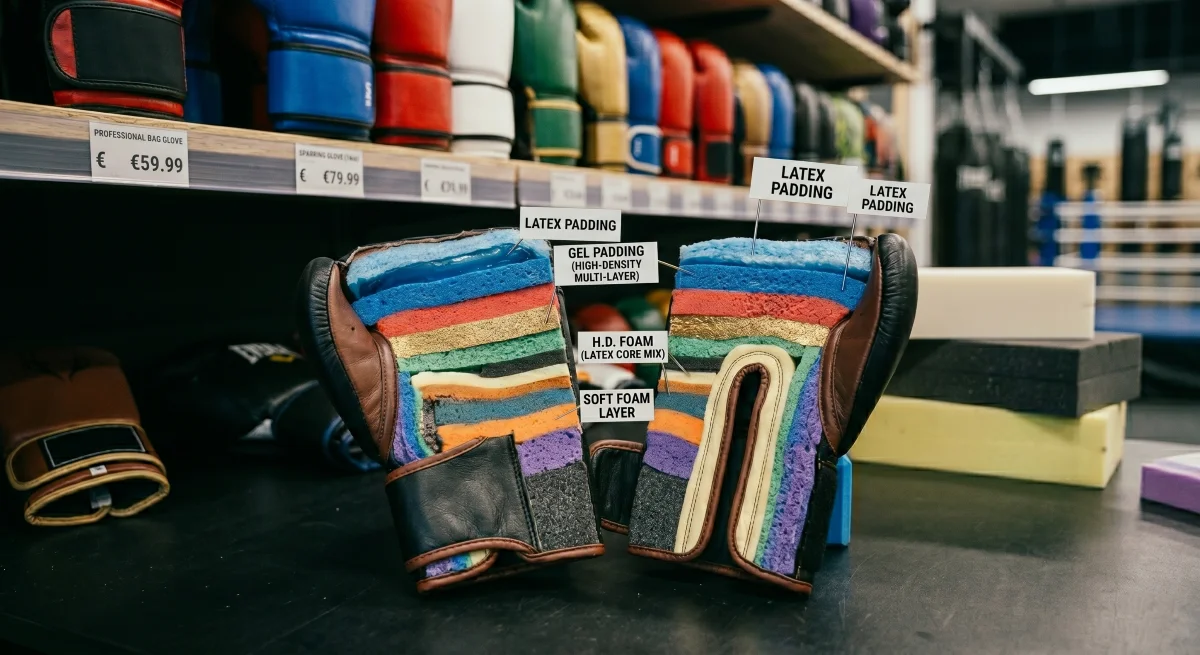
While the exterior of a glove tells you about its durability, the internal padding determines how much protection your knuckles get. Whether you are following our boxing gloves buying guide or looking for professional gear, understanding foam types is crucial.
1. IMF (Injected Molded Foam)
Injected Molded Foam (IMF) represented a revolution in boxing safety. Unlike traditional methods where sheets of foam are glued together, IMF is created by injecting a liquid chemical mixture into a pre-set mold, resulting in a single, anatomically correct piece of padding that perfectly mimics the shape of a fist.
This process ensures that every glove has the exact same density and shape. For beginners, this is the gold standard because it forces the hand into a proper position, reducing the risk of "novice fractures." However, keep in mind that because IMF is a single solid block, it can feel "bouncy" or stiff during the first few weeks of training.
- Best for: Beginners, cardio boxing, and high-volume bag work.
- Durability: Highly durable; the foam won't shift or develop gaps over time.
Commonly found in many of the best boxing gloves for beginners.
2. Multi-Layered Foam (MLF)
Multi-layered padding is an art form. It involves stacking different densities of foam—such as latex, high-density EVA, and open-cell sponge—to create a specific "feel." The goal is to provide a soft touch on the knuckles while the denser core absorbs heavy impacts.
The secret lies in the sequence: a soft outer layer protects your sparring partner's face, while a dense middle layer prevents your knuckles from bottoming out against the heavy bag. This layering allows for a "broken-in" feel right out of the box, offering a level of feedback and "pop" that IMF simply cannot match.
- Best for: Sparring and heavy bag work.
- Pros: Superior impact absorption, custom "broken-in" feel.
- Cons: More expensive, layers can break down over time.
Expert Tip: Most sparring gloves use multi-layered foam to protect both you and your partner.
3. Horsehair Padding
Old-school but still used in pro fights, horsehair is known as "the puncher's padding." Before modern polymers, boxing gloves were stuffed with animal hair, but horsehair was chosen for a very specific scientific reason.
The Science of the Strand: Horsehair is uniquely resilient. Unlike wool, which compresses and "felts" into a hard, lumpy ball, horsehair fibers are hollow and springy. They provide shock absorption while remaining incredibly thin. Why not cotton? Cotton has zero "rebound" and would offer no protection after just one round.
History & Strategy: In the early 20th century, horsehair was the only material that could survive a 15-round fight. Today, pro fighters like Canelo Alvarez use "hybrid" horsehair gloves (like Cleto Reyes). During a fight, the hair shifts away from the knuckles, leaving only a thin foam layer. This transmits maximum force, often at the expense of the wearer's hands.
- Why not sheep's wool? Wool absorbs sweat, becomes heavy, and loses all protective qualities.
Quick Comparison Table
| Padding Type | Shock Absorption | Durability |
|---|---|---|
| IMF | High (Uniform) | Excellent |
| Multi-Layered | Very High (Dynamic) | Good |
| Horsehair | Low | Low |
How to Tell if Your Padding is "Dead"
Even the best foam doesn't last forever. Using gloves with collapsed padding is a fast track to wrist and knuckle injuries. Here are three signs it's time to replace them:
1. The "Knuckle Test"
Press hard on the hitting surface. If you can feel your own knuckles through the foam, the padding has bottomed out.
2. Lumps & Gaps
If the foam has shifted, leaving "hollow" spots or hard lumps, the structural integrity is gone. This is common in low-quality multi-layered gloves.
3. The "Snap" Test
IMF foam should bounce back instantly. If you press it and it leaves a permanent dent or reacts slowly, the chemicals have degraded.
Proper maintenance can prolong this process. Make sure to check our guide on how to clean boxing gloves to prevent sweat from breaking down the foam fibers.
Padding & Foam: FAQ
How often should I replace gloves based on padding?
If you feel your knuckles hitting the bag or notice the foam is lumpy, it's time for a change. Proper glove maintenance can extend padding life.
Does glove weight affect the type of foam?
Yes. Heavier gloves (14-16 oz) usually contain more layers of foam. Check our size guide for more info.
Related Articles and Reviews
Check it now