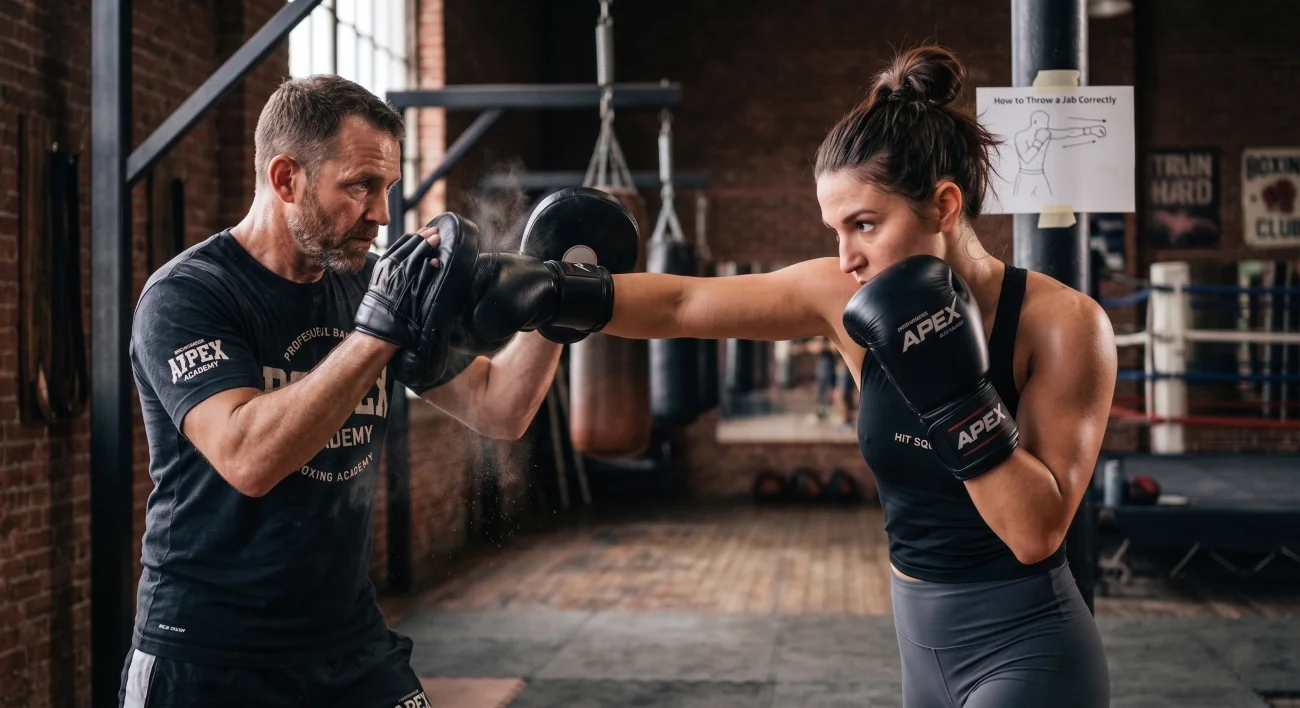
How to Throw a Jab Correctly
The jab looks simple until you actually try to use it in a real boxing round.
Many beginners think a jab is just a quick left hand. They flick it out, pull it back slowly, drop the other hand, lean forward, or reach for the target. On the heavy bag it may still make noise, but in sparring the same jab feels weak, predictable, and easy to counter.
A correct jab is not only a punch. It is your range finder, rhythm breaker, setup punch, and safest way to touch an opponent without giving away your balance.
If this sounds familiar, you are not alone. Most beginners struggle with the jab because they try to punch with the arm before they understand stance, balance, shoulder position, foot pressure, and recovery.
This guide breaks down how to throw a jab correctly: basic mechanics, common mistakes, bag work, shadowboxing, and simple drills.
If you are still building your fundamentals, this article fits naturally with our guides on basic boxing footwork, how to shadow box for beginners, and how to hit a heavy bag properly.
Quick Answer: What Is the Correct Way to Throw a Jab?
To throw a jab correctly, start from a balanced boxing stance, push lightly from the rear foot, send the lead hand straight to the target, turn the fist over near the end, protect your chin with the lead shoulder, keep the rear hand up, and bring the jab straight back to guard.
The jab should feel sharp, balanced, and recoverable.
A good jab usually has five parts:
- Stable stance before the punch
- Small push from the floor
- Straight lead hand path
- Shoulder protecting the chin
- Fast return to guard
The biggest mistake is thinking only about the hand. The jab starts from balance and ends with balance.
Why the Jab Matters So Much in Boxing
The jab is often the first punch a boxer learns, but it is also one of the last punches a boxer truly masters.
A beginner uses the jab to touch the bag. A better boxer uses it to control distance. A good boxer uses it to make the opponent react. A very good boxer can win entire rounds by making the jab feel annoying, sharp, and hard to predict.
The jab helps you:
- Measure distance before throwing power shots
- Stop an opponent from rushing in
- Set up the cross, hook, and body shots
- Break the opponent's rhythm
- Enter and exit safely
- Keep your own balance during combinations
What usually happens with beginners is different. They throw the jab because the coach says “jab,” but they do not know what the jab is supposed to do. So it becomes a loose arm punch with no purpose.
That is why the jab changes the way you box.
Start With the Right Stance Before You Jab
Your Jab Is Only as Good as Your Balance
Before you worry about speed, power, or snap, check your stance.
If your feet are too narrow, the jab will pull you forward. If your feet are too wide, you will feel stuck. If your weight is too far over the front foot, you will reach. If your weight is too far back, the jab will feel weak and late.
For orthodox boxers, the left hand is usually the jab. For southpaws, it is usually the right hand. The principle is the same: your lead hand punches while your stance stays stable.
A simple starting point:
- Feet about shoulder-width apart
- Lead foot pointed slightly inward or forward
- Rear heel light, not glued to the floor
- Knees slightly soft
- Chin down
- Hands high enough to protect your face
Do not stand tall and stiff. You should feel athletic, like you can step, slip, jab, or move without preparing first.
Do Not Lean Into the Jab
One of the most common beginner mistakes is leaning the head forward with the punch.
It feels like extra reach, but it gives your opponent your chin. The bag will not punish this. Sparring will.
Think of your jab as extending from your stance, not falling out of your stance.
How to Throw a Jab Correctly Step by Step
Step 1: Set Your Guard
Start with both hands up. Your rear hand should stay close to your cheek or chin. Your elbows should not flare out wildly.
Many beginners drop the rear hand when they jab. This creates a bad habit. The jab is supposed to be safe. If your rear hand drops every time, your jab becomes an invitation for a counter right hand.
Step 2: Push Lightly From the Floor
The jab is not a huge power punch, but it still comes from the floor.
You do not need a dramatic step every time. Sometimes the jab is thrown in place. Sometimes it comes with a small step. Either way, your feet, shoulder, and hand should feel connected.
A good cue is: push the punch out from your stance, not from your shoulder alone.
Step 3: Send the Lead Hand Straight
The jab should travel directly to the target. Not in a loop. Not from the hip. Not with the elbow lifting first.
Imagine your fist moving down a narrow line from your guard to the target. The shorter the path, the harder it is to see.
This is where many beginners make the jab slow without realizing it. They pull the hand back before punching, flare the elbow, or drop the hand and then lift it. Every extra movement gives the opponent information.
Step 4: Turn the Fist Over Near the End
As the jab lands, the knuckles should face the target and the palm usually turns down. Do not overthink it: keep the wrist straight, land with the front knuckles, and avoid flaring the elbow early.
If your wrist bends on impact, slow down and fix it. Hand position matters, especially when you start hitting the heavy bag harder. Our guide on how to strengthen your wrists for boxing goes deeper into wrist and fist preparation.
Step 5: Protect Your Chin With the Shoulder
As your jab extends, your lead shoulder should rise slightly to protect your chin. This does not mean shrugging hard or becoming tense. It means your punch and defense are connected.
Your chin should stay tucked behind the shoulder line. Your eyes stay on the target. Your rear hand stays home.
Step 6: Bring the Jab Straight Back
The return is just as important as the extension.
A slow jab back to guard is a common reason beginners get countered. They throw the punch, admire it, and leave the hand floating in the air.
Think: out and back on the same line.
Common Beginner Jab Mistakes
Mistake 1: Reaching Instead of Stepping
If the target is too far away, many beginners stretch the arm and lean forward.
The fix is simple but not always easy: move your feet. Either step in with the jab or accept that the target is out of range.
A jab that reaches too far becomes weak and dangerous. A jab from the right distance feels shorter, cleaner, and safer.
Mistake 2: Dropping the Rear Hand
This is probably the most common jab mistake in beginner sparring.
The lead hand goes out, the rear hand falls, and the boxer becomes open down the middle.
Practice slowly in the mirror or during shadowboxing. Every jab should return to a complete guard.
Mistake 3: Throwing the Same Jab Every Time
A jab can be fast, stiff, light, touching, distracting, defensive, or used to step in. Beginners often throw the same medium-speed jab over and over.
That makes it easy to read.
Once your basic mechanics are clean, start changing rhythm. Touch once, step back. Double jab. Jab to the chest. Jab to the head. Jab and move left. Jab and exit right.
Mistake 4: Punching Without a Purpose
Do not jab just because you are bored.
Ask what the jab is doing. Is it measuring distance? Setting up the cross? Stopping pressure? Keeping the bag at range? Starting a combination? Creating an angle?
A simple jab with a clear purpose is better than a fast jab with no idea behind it.
Jab Mistake, Consequence, and Fix
| Mistake | What Usually Happens | Simple Fix |
|---|---|---|
| Leaning forward | You lose balance and expose your chin | Step with the jab or stay within range |
| Dropping the rear hand | You are open for counters | Keep the rear glove glued near your cheek |
| Looping the jab | The punch becomes slow and visible | Send the fist straight from guard |
| Slow recovery | Your hand stays out after landing | Snap the jab back on the same line |
| Standing too square | You lose reach and defensive shape | Return to a balanced boxing stance |
| Always jabbing at one speed | Your rhythm becomes predictable | Change speed, level, and timing |
How to Practice the Jab on the Heavy Bag
The heavy bag is useful for learning the jab, but it can also create bad habits if you only care about impact.
Many beginners stand too close to the bag and slap it with the lead hand. The bag moves, the punch makes sound, and it feels productive. But the range is wrong, the feet are dead, and the guard is lazy.
Instead, use the heavy bag to practice distance and recovery.
- Stand just outside jab range
- Step in with the jab
- Land with a straight wrist
- Bring the hand back immediately
- Step out or angle off after the punch
A good beginner drill is simple: jab, reset, jab, reset. Do not rush combinations at first.
After that, try double jab, jab-cross, jab to head then jab to body, and jab while circling. If your heavy bag rounds always become wild punching, read our guide on common heavy bag mistakes.
The jab on the bag should teach distance, balance, and clean recovery. It is not only about making the bag swing.
How to Practice the Jab in Shadowboxing
Shadowboxing is one of the best places to fix your jab because there is no bag to distract you.
Without impact, you can feel the real problem. Are you off balance? Is your rear hand dropping? Are you reaching? Are you bringing the jab back slowly? Are your feet moving with the punch?
Try this simple shadowboxing round:
- First minute: single jab only
- Second minute: jab with a small step in and step out
- Third minute: jab, move left, jab, move right
Do not rush. The goal is not to look flashy. The goal is to make the jab feel automatic.
If you are new to this, start with our full guide on how to shadow box for beginners.
Different Types of Jabs Beginners Should Know
The Basic Jab
This is your clean straight jab from stance. It teaches the foundation: straight line, chin protected, rear hand up, fast recovery.
The Step Jab
The step jab helps you close distance. Your lead foot steps as the jab travels. The rear foot follows after so your stance does not become too long.
This is useful when the opponent or bag is just outside range.
The Double Jab
The double jab is not just two identical punches. The first jab can measure or distract. The second can land harder or help you enter.
Many beginners throw the first jab and stop. A double jab teaches you to keep working without overcommitting.
The Body Jab
A body jab can be very effective, but beginners often do it badly by bending at the waist and dropping the head forward.
The safer version is to bend the knees slightly, keep your eyes up, and return to guard fast. Do not dive in with your face.
The Touch Jab
Not every jab has to be hard. A light touch jab can distract, measure, or force a reaction.
This is important because beginners often think every punch must be thrown at full power. That same problem appears in heavy bag training too, especially when people train every round like a fight.
Simple Jab Combinations for Beginners
Once your single jab feels clean, add simple combinations. Do not jump straight into long pro-style combinations if the first punch is still messy.
Start with:
- Jab-cross
- Double jab-cross
- Jab-cross-step out
- Jab to head, jab to body
- Jab-cross-lead hook
- Jab, pivot, jab again
The jab should make the rest of the combination easier. If your jab pulls you off balance, the cross after it will be late or forced.
Think of the jab as opening the door. The power punch walks through that door only if the position is good.
Jab Safety: Hands, Wrists, and Gear
A correct jab should land with a straight wrist and the first two knuckles aligned as much as possible. If your wrist bends every time you hit the bag, do not solve it by punching harder. Fix the position.
Hand wraps matter here. They help support the wrist and keep the hand organized inside the glove. If you are unsure, read our guide on how to wrap your hands for boxing or the heavy-bag version on wrapping hands for heavy bag training.
Glove choice matters too. You do not need the most expensive gloves, but you do need gloves that fit and protect your hands. See our boxing gloves size guide and best boxing gloves for heavy bag.
Good gear will not fix bad technique, but bad gear can make beginner mistakes more painful.
Beginner Tips to Improve Your Jab Faster
- Practice the jab slowly before trying to make it fast.
- Film yourself from the front and side to check balance.
- Use shadowboxing to fix mechanics before bag rounds.
- Do not let the rear hand drop when the jab leaves.
- Change the jab rhythm so it does not become predictable.
- Step only as far as your stance can recover.
- Use the jab to set up movement, not just punches.
A useful rule: if your jab makes you less balanced, it is not ready to be faster yet.
FAQ: How to Throw a Jab Correctly
Should a jab be powerful or fast?
A jab should be sharp, balanced, and useful. Sometimes it is fast and light. Sometimes it is stiff and disruptive. Beginners should first focus on clean mechanics and recovery before chasing power.
Do you step with every jab?
No. You can jab in place, step in with the jab, jab while moving backward, or jab while circling. The key is choosing the right jab for the distance.
Why does my jab feel weak?
Usually because you are punching only with the arm, standing too tall, reaching, or throwing from poor balance. A better stance and small push from the floor usually make the jab feel sharper.
Should I turn my fist over when I jab?
In most basic boxing instruction, yes, the fist turns over near the end of the jab so the knuckles face the target and the palm points down. Keep the wrist straight and avoid over-rotating.
How do I stop dropping my right hand when I jab?
Slow the punch down and practice in front of a mirror. Keep the rear glove near your cheek during every jab. Shadowboxing is usually the best place to fix this habit.
Is the jab useful on the heavy bag?
Yes, but only if you use it properly. Practice range, timing, stepping in, stepping out, and clean recovery. Do not just slap the bag from too close.
How often should beginners practice the jab?
Almost every boxing session can include jab practice. Even a few focused rounds of shadowboxing or bag work can help. For broader training structure, see our guide on how often you should train boxing.
Final Thoughts: Build Your Boxing Around a Better Jab
Learning how to throw a jab correctly is one of the best investments a beginner boxer can make.
The jab teaches balance, distance, timing, defense, footwork, and patience. It also exposes beginner mistakes: leaning, reaching, dropping the hands, punching without purpose, and rushing combinations.
Start simple. Clean stance. Straight punch. Shoulder up. Rear hand home. Fast return. Then add steps, rhythm changes, double jabs, body jabs, and combinations.
A flashy combination is useless if the first jab breaks your balance. A clean jab, even a simple one, can make the rest of your boxing feel more organized.