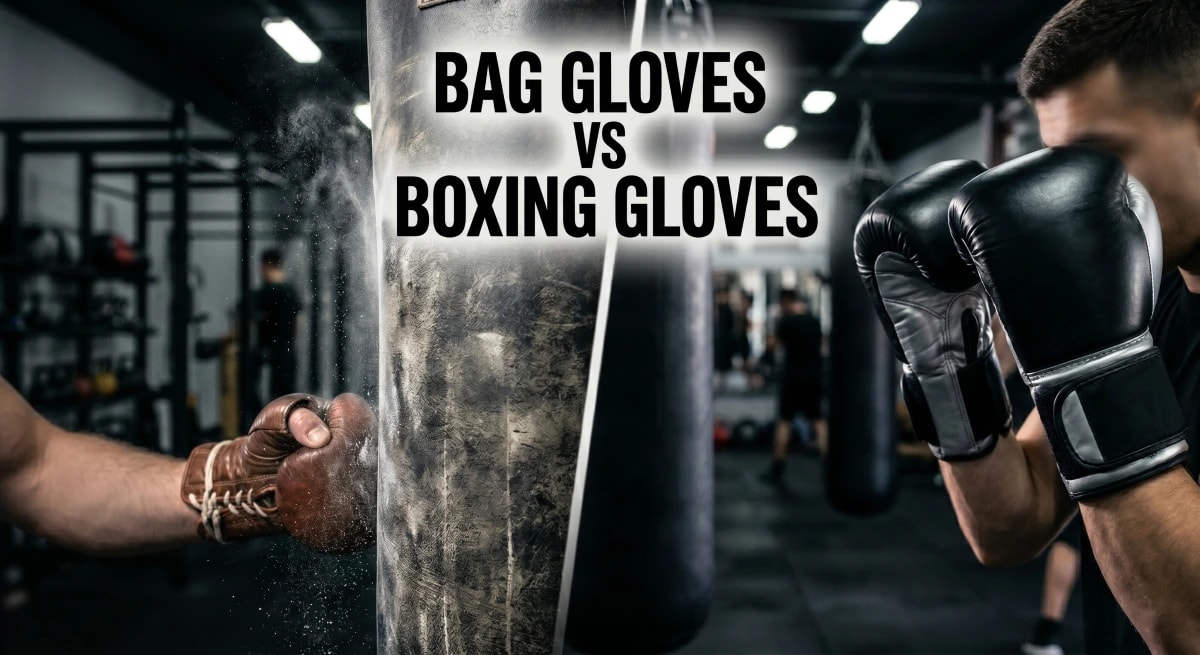
Bag Gloves vs Boxing Gloves: What Is the Difference?
Bag gloves vs boxing gloves is one of those gear questions that sounds simple until you actually start shopping. Some gloves are called heavy bag gloves, some are called training gloves, some say boxing gloves, and some brands use all of those words on the same product page.
The practical difference is this: bag gloves are built mainly for hitting bags and pads, while general boxing gloves are usually designed for broader training use, including bag work, mitts, drills, and sometimes sparring. The problem is that not every “boxing glove” is safe for sparring, and not every “bag glove” gives enough wrist support for hard heavy bag rounds.
If you are a beginner, you do not need five pairs of gloves right away. But you do need to understand what each type is made for. The wrong glove can feel harsh on your knuckles, unstable around the wrist, too bulky for technique work, or too dense for partner drills.
This guide breaks down the real differences between bag gloves and boxing gloves in plain language: padding, wrist support, durability, punch feel, versatility, training use, and common mistakes beginners make when choosing their first pair.
If you are still building your setup, you may also want to read our guide on how to choose boxing gloves and our boxing gloves size guide.
Quick Answer: Should You Buy Bag Gloves or Boxing Gloves?
For most beginners, the best first choice is a good pair of all-around boxing training gloves, usually in 12 oz, 14 oz, or 16 oz depending on your body size and training style.
Choose dedicated bag gloves if your training is mostly heavy bag work, punch mitts, and solo conditioning. They usually feel more compact, more responsive, and more durable against repeated bag impact.
Choose general boxing gloves if you want one pair for classes, drills, bag work, and beginner training. Just remember: if you plan to spar, you need proper sparring gloves or coach-approved training gloves, not dense bag gloves.
Simple rule: bag gloves are for equipment; sparring gloves are for partners; training boxing gloves sit somewhere in the middle depending on the model.
Bag Gloves vs Boxing Gloves Comparison Table
| Feature | Bag Gloves | General Boxing Gloves |
|---|---|---|
| Main purpose | Heavy bag, double-end bag, mitts | General boxing training |
| Padding feel | Often denser and more compact | Usually more balanced |
| Wrist support | Can be very strong, especially in bag-specific models | Varies by glove and closure system |
| Durability | Built for repeated equipment impact | Depends on whether glove is training, sparring, or budget-focused |
| Punch feedback | Sharper, more connected feel | Softer or more cushioned feel |
| Versatility | Lower; not ideal for sparring | Higher; can work for more drills |
| Best for | Heavy bag rounds and pad work | Beginners, classes, mixed training |
| Common mistake | Using dense bag gloves for sparring | Using soft sparring gloves for constant hard bag work |
What Are Bag Gloves?
Bag gloves are boxing gloves designed mainly for hitting equipment. That usually means heavy bags, aqua bags, double-end bags, wall bags, and punch mitts.
The key idea is repeated impact. When you hit a heavy bag for round after round, the glove has to protect your hands while surviving thousands of punches against a firm surface. Because of that, many bag gloves use denser padding, compact shaping, and stronger wrist structures.
A good bag glove should help you make a proper fist, keep the wrist aligned, and give enough feedback so you can feel whether you are landing correctly. If your wrist bends every time you throw a hook, or your knuckles feel exposed after two rounds, the glove is not doing its job.
Some modern bag gloves look almost identical to regular boxing gloves. Others are clearly labeled as bag gloves and may have a more compact profile. For example, gloves like the Rival RB11 Evolution Bag Gloves or TITLE Gel World Bag Gloves are made with heavy bag training in mind, while many all-around models are marketed more broadly as boxing training gloves.
Bag gloves are not automatically better or worse. They are more specialized. That specialization is useful if you spend a lot of time hitting the bag, but it becomes a problem if you try to use the same dense glove for sparring.
What Are Boxing Gloves?
The term “boxing gloves” is broader. It can describe training gloves, sparring gloves, bag gloves, fight gloves, beginner gloves, and fitness gloves. That is why shopping gets confusing.
When most beginners say “boxing gloves,” they usually mean all-around training gloves. These are gloves you can use for boxing classes, light bag work, mitts, partner drills, and basic technique practice. They are designed to cover more situations instead of being perfect for one exact job.
However, you still need to check what the glove is actually designed for. A cheap “boxing glove” may be fine for fitness classes but poor for hard heavy bag training. A premium boxing glove may be excellent for sparring but too soft to abuse on the bag every day. The label matters less than the build.
Padding: Dense Bag Protection vs Balanced Training Cushion
Padding is the biggest difference between bag gloves and boxing gloves.
Bag gloves often use denser foam because the glove is expected to strike firm equipment over and over. Dense padding can give better punch feedback and may last longer on heavy bags. You feel the shot more clearly, which can help you notice whether your knuckles are landing flat or your wrist is collapsing.
The downside is that dense padding is not partner-friendly. A glove that feels great when cracking the heavy bag can feel too hard in sparring. That is why coaches usually do not want students sparring in dedicated bag gloves.
General boxing gloves vary more. Some have soft, pillowy padding for sparring. Some have layered foam for all-around training. Some budget gloves have padding that feels fine at first but breaks down quickly after regular bag use.
If you only hit the heavy bag, dense and durable padding makes sense. If you train in a class where you rotate between bag work, mitts, defensive drills, and partner exercises, a balanced training glove is usually easier to live with.
If you want to understand glove padding more deeply, read our boxing glove foam types and padding guide.
Wrist Support: Why Bag Work Exposes Weak Gloves
Heavy bag training punishes bad wrist support. The bag does not move like a human partner. It is heavy, firm, and repetitive. If your punch lands slightly wrong, the impact pushes back through your wrist.
Good bag gloves usually pay attention to wrist alignment. They may use longer cuffs, stronger hook-and-loop closures, angled wrist designs, or layered support around the lower hand. The goal is to keep your fist and forearm connected when impact lands.
General boxing gloves can also have excellent wrist support, but the range is wider. Some beginner gloves have soft wrists and loose closures. They may feel comfortable in the store but unstable once you start throwing hard crosses and hooks.
This is one reason beginners should not choose gloves only by color, brand, or price. Wrist support is not decorative. It affects confidence, safety, and technique.
Hand wraps also matter. Even a strong glove should be used with proper wraps for bag work. If you are not confident with wrapping, start with our guide on how to wrap your hands for heavy bag training.
Durability: Which Gloves Last Longer?
Bag gloves are usually more durable for heavy bag training because that is exactly what they are built for. The outer material, stitching, padding density, and wrist structure are often chosen with repeated equipment impact in mind.
General boxing gloves can last a long time too, but it depends on the model. A high-quality training glove can handle regular bag work well. A soft sparring glove may protect partners beautifully but lose shape faster if you smash it into the heavy bag every day.
This is where many beginners accidentally waste money. They buy one nice pair of gloves, use it for everything, and then wonder why the padding feels dead after months of hard bag rounds. The glove was not necessarily bad. It may just have been used for the wrong job.
If you train once or twice a week, one pair of all-around gloves may be enough for a while. If you train hard three to five times per week, it often makes sense to separate your gloves: one pair for bag and pad work, another pair for sparring.
For more detail, read how long boxing gloves last.
Versatility: One Pair or Separate Gloves?
General boxing gloves are more versatile than dedicated bag gloves. That is their main advantage.
If you are new to boxing, you may not know yet whether you will train mostly on the heavy bag, join group classes, do mitt work, or eventually spar. A solid training glove gives you room to explore without buying multiple pairs immediately.
Bag gloves are less flexible. They are excellent for what they are made for, but they are not the best option for partner contact. If your gym includes technical sparring, Dutch drills, defense drills, or touch-contact rounds, your coach may not allow hard bag gloves.
The most practical path is simple:
- Beginner with mixed classes: start with all-around training gloves.
- Heavy bag focused training: consider dedicated bag gloves.
- Regular sparring: buy separate sparring gloves.
- High weekly volume: separate bag gloves and sparring gloves to protect both your hands and your partners.
If you want one broad recommendation, look at our best boxing gloves for training guide.
Punch Feel: Feedback vs Cushion
Punch feel is personal, but it matters.
Bag gloves usually give sharper feedback. When you land cleanly, you feel it. When your wrist bends or your knuckles land unevenly, you also feel that. This can be useful because the glove teaches you something about your punch mechanics.
General boxing gloves often feel more cushioned. This can be better for beginners who are still building confidence and hand conditioning. A softer glove may feel more forgiving, especially during long classes.
If you are hitting hard, punch feel should never come at the cost of safety. Pain in the knuckles, wrist, or thumb is not just “normal boxing.” It can be a sign that your wraps, glove fit, punching technique, or glove type needs attention.
Training Use: When Each Glove Makes Sense
Use Bag Gloves For
- Heavy bag rounds
- Double-end bag drills
- Punch mitts
- Power punching practice
- Conditioning rounds
- Boxers who already have separate sparring gloves
Use General Boxing Gloves For
- Beginner boxing classes
- Mixed bag and mitt sessions
- Technique drills
- Fitness boxing
- General gym training
- Learning basic combinations
If you already know you love heavy bag training and you are doing several bag sessions every week, then a dedicated bag glove becomes easier to justify.
Real-World Use: What Actually Happens in the Gym
In real gyms, most beginners start with one pair of gloves. They use that pair for everything: warmups, bag work, mitts, drills, and sometimes beginner sparring. This is normal, but it is not ideal forever.
At first, one pair is practical. You are still learning what kind of training you enjoy. You may not know whether you will stay consistent. Spending money on separate gloves immediately can be unnecessary.
After a few months, patterns become clearer. Some people love the heavy bag and rarely spar. They need durable bag gloves with good wrist support. Others join a boxing gym and begin controlled sparring. They need softer, partner-safe gloves. Some people do both and should eventually separate their gear.
The smartest approach is to match the glove to the session. If today is heavy bag and mitts, bag gloves are fine. If today includes sparring or partner contact, use sparring-appropriate boxing gloves and ask your coach if you are unsure.
Common Mistakes Beginners Make
Mistake 1: Using Bag Gloves for Sparring
This is the biggest mistake. Bag gloves can be too dense for partner contact. Even if they protect your hands, they may be unpleasant or unsafe for the person you are sparring with.
Mistake 2: Buying Gloves Only by Ounce Weight
Ounce weight matters, but it does not tell the whole story. Two 16 oz gloves can feel completely different depending on padding density, shape, wrist support, and hand compartment.
Mistake 3: Ignoring Hand Wraps
Gloves are not a replacement for wraps. Wraps help stabilize the wrist and protect the small bones of the hand. For heavy bag work, this is especially important.
Mistake 4: Expecting One Pair to Do Everything Forever
One pair is fine when you start. But if you train seriously, your gear should become more specific. Bag work and sparring place different demands on gloves.
Best Choice by Situation
Best for Beginners
Choose all-around boxing training gloves. They are more forgiving, more versatile, and better for mixed beginner classes.
Best for Heavy Bag Training
Choose dedicated bag gloves with strong wrist support and durable padding. This is especially useful if you hit the bag hard several times per week.
Best for Sparring
Choose proper sparring gloves. Do not use dense bag gloves unless your coach specifically approves them for a controlled drill.
Best for Fitness Boxing
A comfortable general boxing glove is usually enough. You do not need expensive professional bag gloves for casual cardio boxing.
Best for Serious Training
Use two pairs: one durable pair for bag and pad work, and one softer pair for sparring. This protects your hands, your partners, and the lifespan of both gloves.
FAQ: Bag Gloves vs Boxing Gloves
Are bag gloves the same as boxing gloves?
No. Bag gloves are a type of boxing glove made mainly for hitting equipment. General boxing gloves are broader and may be designed for training, sparring, fitness, or competition depending on the model.
Can I use boxing gloves on a heavy bag?
Yes, many boxing training gloves can be used on a heavy bag. The important thing is that they have enough padding, wrist support, and durability for repeated impact. Very soft sparring gloves are not ideal for constant hard bag work.
Can I use bag gloves for sparring?
Usually no. Dedicated bag gloves are often too dense for sparring. They may protect your hands but feel too hard on your partner. Use sparring gloves for sparring and ask your coach if you are unsure.
What oz gloves should I use for bag work?
Many adults use 12 oz, 14 oz, or 16 oz gloves for bag work. Smaller fighters may prefer 12 oz, while larger beginners often use 14 oz or 16 oz. Fit, wrist support, and padding quality matter as much as the number.
Are bag gloves better for heavy bag training?
For frequent heavy bag training, yes, dedicated bag gloves can be better because they are designed for equipment impact. For casual beginner training, all-around boxing gloves may be more practical.
Do I need separate gloves for bag work and sparring?
If you spar regularly, yes. Separate gloves are the better long-term choice. Bag gloves take equipment abuse, while sparring gloves should stay softer and safer for partners.
Conclusion: Which Should You Choose?
If you mostly hit bags and pads, bag gloves make sense because they are built for repeated equipment impact, stronger feedback, and long-term durability.
If you are a beginner or train in mixed boxing classes, start with all-around boxing gloves. They give you more flexibility while you learn what kind of training you actually do most.
Related Articles and Reviews
Check it now