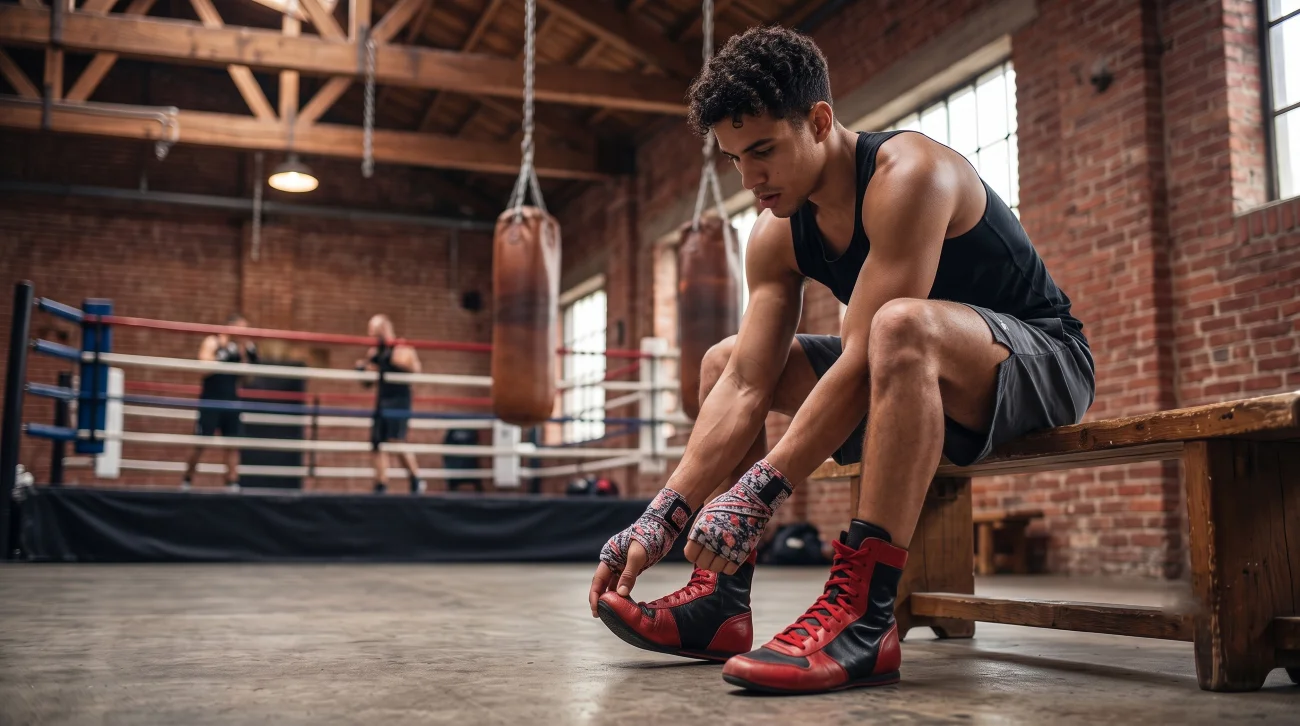
How Should Boxing Shoes Fit?
Boxing shoes should feel snug, secure, and close to the foot without crushing your toes or creating painful pressure points.
That sounds simple, but many beginners choose boxing shoe size the same way they choose running shoes. They leave too much room for comfort, wear thick socks to fill the space, or assume ankle support will compensate for a loose forefoot.
What usually happens is the foot slides inside the shoe when they pivot, the heel lifts during movement, and the boxer starts tightening the laces harder and harder. The shoe may feel secure while standing still, but unstable once footwork begins.
A good boxing shoe fit should keep your heel locked down, hold the midfoot firmly, and leave just enough room for your toes to stay natural. You should be able to move, pivot, and push off without your foot shifting inside the shoe.
This guide explains how boxing shoes should fit, how much toe room you need, how tight the ankle should feel, and how to tell whether a pair is too small or too big.
Quick Answer: How Tight Should Boxing Shoes Be?
Boxing shoes should fit more snugly than everyday sneakers but should not feel painfully tight. Your heel should stay in place, your midfoot should feel supported, and your toes should have a small amount of room without sliding forward.
A practical target is a close performance fit with roughly a thumb-width or less of space in front of the longest toe, depending on the shape of the shoe and your foot.
The most important test is movement. If your heel lifts, your foot slides during pivots, or you need to curl your toes to feel stable, the shoes are probably too large. If your toes are compressed, the sides of your feet go numb, or pressure becomes painful after a few minutes, they are too small or too narrow.
How Boxing Shoes Should Fit in Each Area
| Area | Correct Fit | Warning Sign |
|---|---|---|
| Heel | Locked down with little or no lifting | Heel slides when stepping or bouncing |
| Midfoot | Firm and supported | Foot moves sideways inside the shoe |
| Toe box | Close but not compressed | Toes curl, overlap, or become numb |
| Width | Secure contact without painful pressure | Outer foot bulges strongly or burns |
| Ankle | Supported without restricting natural movement | Collar digs into the ankle or lower leg |
| Laces | Even tension from forefoot to ankle | You must overtighten one area to stop movement |
The Heel Should Stay Locked Down
Heel movement is one of the clearest signs of a poor boxing shoe fit.
When you step forward, push backward, or pivot, your heel should remain seated in the rear of the shoe. A tiny amount of movement may be normal in some models before they break in, but obvious lifting is a problem.
A loose heel reduces control. It also encourages you to grip with your toes or overtighten the ankle laces, neither of which fixes the actual sizing issue.
The Midfoot Should Feel Firm
Boxing shoes are supposed to feel connected to your feet. The middle of the shoe should wrap around the arch and sides without leaving a soft, empty pocket.
This is especially important during lateral movement. When you step to the side or angle out, your foot should move with the shoe rather than slide across the insole.
Many beginners mistake side-to-side movement for normal flexibility. It is not. Flexibility should come from the shoe bending with your foot, not from your foot moving independently inside it.
The Toe Box Should Be Close, Not Cramped
Your toes need enough room to lie naturally. They should not be curled, pressed together, or touching the front hard enough to feel pressure while standing.
At the same time, too much toe room can make the shoe feel disconnected. During quick stops, your foot may slide forward and your toes may repeatedly hit the end of the shoe.
The ideal fit is close enough that the shoe feels precise but roomy enough that your toes can stay relaxed.
Snug vs Too Tight: The Difference Beginners Miss
A snug shoe creates even contact around the foot. A shoe that is too tight creates concentrated pressure.
That distinction matters.
A new boxing shoe may feel firmer than your normal sneakers, especially around the midfoot and ankle. That does not automatically mean it is too small.
However, you should not expect painful pressure to disappear through break-in. Materials may soften slightly, but the shoe will not become dramatically longer or wider.
- Normal snugness: even contact, secure heel, firm upper, no pain.
- Too tight: numb toes, burning on the sides, sharp pressure, throbbing, or restricted circulation.
- Too loose: heel lift, sliding forefoot, bunching upper, or constant lace adjustment.
If this sounds familiar, do not assume you simply need to “break them in.” A performance fit should still be wearable from the beginning.
For a broader comparison of models and fit styles, see our guide to the best boxing shoes for beginners.
How Much Toe Room Should Boxing Shoes Have?
There is no perfect measurement for every boxer because foot shape and shoe construction vary. Still, most people should look for a small amount of space in front of the longest toe rather than a large running-shoe gap.
Your toes should not touch the end while standing normally. They also should not slam into the front when you take a hard step or stop quickly.
Try this simple check:
- Put on the socks you actually use for boxing.
- Lace the shoes evenly.
- Stand with your full weight on both feet.
- Push your foot gently forward.
- Check whether your heel can still move noticeably behind you.
If there is a large gap behind the heel, the shoe is likely too long. If your longest toe is already pressed firmly into the front before movement, it is too short.
Remember that one foot is often slightly larger than the other. Fit the shoes to the larger foot.
How Should Boxing Shoes Fit If You Have Wide Feet?
Width causes more fit problems than length for many boxers.
A narrow boxing shoe can feel correct at the heel and still be wrong through the forefoot. Common signs include pressure along the outside edge, numbness near the little toe, or the upper visibly stretching over the widest part of the foot.
Do not automatically size up just to gain width. A longer shoe may relieve side pressure but create heel lift and too much space in front.
The better solution is a model with a wider last, a more forgiving upper, or a dedicated wide option.
If you are between sizes because of width, compare the brand's official size chart and check whether the specific model is described as narrow, regular, or wide. The fit of one model does not represent the entire brand.
How Tight Should Boxing Shoes Feel Around the Ankle?
The ankle area should feel supported, but the shoe should not act like a rigid brace.
You still need natural ankle movement for stance changes, pivots, and weight transfer. If the collar digs into your ankle bone or the upper cuts into your lower leg when you bend your knees, the fit or lacing may be wrong.
High-top boxing shoes provide more coverage and a more secure feeling. Low-top models usually feel freer and lighter. Neither is automatically better; the correct choice depends on how much support you like and how mobile you want the ankle to feel.
Our comparison of high-top vs low-top boxing shoes explains the tradeoff in more detail.
A low-top model can feel more natural if you dislike pressure around the lower leg, but the heel and midfoot still need to remain secure.
Lacing Can Improve Fit, but It Cannot Fix the Wrong Size
Good lacing distributes pressure from the forefoot to the ankle. The shoe should feel evenly secure rather than loose at the bottom and painfully tight at the top.
Many beginners pull the ankle section as tight as possible because the heel is moving. This can create discomfort without stopping the foot from sliding inside an oversized shoe.
A better approach is:
- Seat your heel firmly in the back of the shoe.
- Tighten the lower laces enough to secure the forefoot.
- Use even tension through the midfoot.
- Finish with supportive, not extreme, tension around the ankle.
- Stand and move before deciding whether the fit is correct.
If the shoe only feels usable when the laces are painfully tight, the shape or size is probably wrong.
How to Test Boxing Shoe Fit at Home
Do not judge boxing shoes only by walking across the room. Boxing movement exposes fit problems that normal walking does not.
Test them indoors on a clean surface so you can still return them if necessary.
- Hold your stance. Your feet should feel planted without pressure forcing them inward.
- Step forward and backward. Check for heel lift and toe impact.
- Move laterally. Your foot should not slide over the insole.
- Pivot slowly. The shoe should rotate with your foot without twisting around it.
- Perform a short shadowboxing round. Notice pressure, numbness, or repeated lace adjustment.
- Keep them on for 15 to 20 minutes. Some width problems appear only after the foot warms up.
This test is more useful than asking whether the shoe feels comfortable while sitting down.
Signs Your Boxing Shoes Are Too Small
- Your toes touch or press into the front while standing.
- Your toes become numb during training.
- You feel sharp pressure at the widest part of the foot.
- The shoe causes burning or tingling after a few minutes.
- Your toenails hurt after repeated forward movement.
- The upper strongly bulges around the forefoot.
- You cannot lace the shoe comfortably without leaving it unusually loose.
Do not ignore numbness. A snug performance shoe should feel secure, not cut off circulation.
Signs Your Boxing Shoes Are Too Big
- Your heel lifts during steps or pivots.
- Your foot slides forward when stopping.
- The upper wrinkles heavily when laced.
- You need very thick socks to make the shoes feel stable.
- Your toes grip the insole during movement.
- You repeatedly retighten the laces during training.
- Your movement feels delayed because the shoe moves before your foot does.
A slightly loose everyday sneaker may be comfortable. A loose boxing shoe usually feels less precise and can interfere with balance.
Wear the Same Socks You Use for Training
Sock thickness changes fit more than many people expect.
Try boxing shoes with the socks you will actually wear in the gym. Thin athletic socks usually make sense because boxing shoes are designed for a close fit.
Using thick socks to rescue a loose shoe is not ideal. The extra material can bunch, trap heat, and still fail to lock the heel properly.
If you train with ankle supports or orthotic insoles, test the shoes with those as well. Adding an insole can reduce both length and volume inside the shoe.
Do Boxing Shoes Stretch or Break In?
Most boxing shoes soften slightly with use, especially through the upper and ankle collar. That can make a firm new pair feel more natural after several sessions.
However, break-in should not be used as an excuse for obvious sizing problems.
- The upper may become more flexible.
- The ankle collar may feel less stiff.
- The insole may compress slightly.
- The shoe will not gain meaningful length.
- A very narrow toe box will not become truly wide.
A shoe that is mildly firm can improve. A shoe that causes pain or numbness is unlikely to become the right fit.
Common Boxing Shoe Sizing Mistakes
Buying the Same Size in Every Brand
Shoe sizing is not perfectly consistent. Your usual size is a starting point, not a guarantee.
Check the specific model's official size chart and read whether the manufacturer describes it as true to size, narrow, wide, or performance-fitting.
Sizing Up to Fix Width
A longer shoe may reduce pressure but create a loose heel. Choose a wider model instead of automatically adding length.
Judging Fit Without Moving
A shoe can feel fine while standing and fail during pivots. Always test boxing-specific movement.
Assuming Pain Is Part of Break-In
Firmness is normal. Pain, numbness, and sharp pressure are not.
Wearing Boxing Shoes Outside
Outdoor use can damage the thin sole and change traction. Keep boxing shoes for the gym, ring, or clean indoor training surfaces.
Should You Size Up or Down in Boxing Shoes?
There is no universal rule that all boxing shoes run small or that every boxer should size up.
Start with your measured foot length and the official chart for the exact model. Then adjust for width, sock thickness, and the manufacturer's fit guidance.
Choose the smaller size only if the larger option creates heel lift or obvious movement and the smaller option still leaves your toes natural.
Choose the larger size only if the smaller option compresses your toes or creates painful pressure. Do not size up merely because the shoe feels more fitted than a running shoe.
For more help choosing between models, read how to choose boxing shoes.
Frequently Asked Questions
Should boxing shoes fit tight?
They should fit snugly, not painfully tight. The heel and midfoot should feel secure, while the toes remain natural and free from numbness or compression.
How much room should be in boxing shoes?
Leave a small amount of space in front of the longest toe. The shoe should not press into the toes, but there should not be enough room for the foot to slide forward.
Should I size up in boxing shoes?
Only if the specific model runs short or narrow enough to compress your foot. Use the manufacturer's size chart rather than applying one sizing rule to every brand.
Is heel lift normal in boxing shoes?
A very small amount may occur in some new shoes, but noticeable heel lift during footwork usually means the shoe is too large, too wide at the heel, or poorly laced.
Do boxing shoes stretch?
They may soften and become more flexible, but they will not stretch enough to correct a shoe that is clearly too short or much too narrow.
Can boxing shoes be too tight around the ankle?
Yes. Ankle support should not cause digging, numbness, or restricted movement. Try adjusting lace tension, but change the model or size if pressure remains.
Should I wear thick socks with boxing shoes?
Usually no. Thin athletic socks work better for a precise fit. Thick socks should not be used to compensate for oversized shoes.
Are boxing shoes supposed to feel like wrestling shoes?
Both can feel lightweight and close-fitting, but boxing shoes are designed around boxing footwork, pivots, and ring movement. See our boxing shoes vs wrestling shoes comparison for the practical differences.
Final Answer: How Should Boxing Shoes Fit?
Boxing shoes should feel like an extension of your feet.
Your heel should stay locked down, your midfoot should feel firmly supported, and your toes should have enough room to remain natural without sliding forward.
The correct fit is snugger than an everyday sneaker but not painful. You should not need thick socks, extreme lace tension, or a long break-in period to make the shoes usable.
The final test is always movement. Step, pivot, circle, and shadowbox. If the shoe moves with your foot and you stop thinking about it, the fit is probably right.
Related Articles and Reviews
Check it now