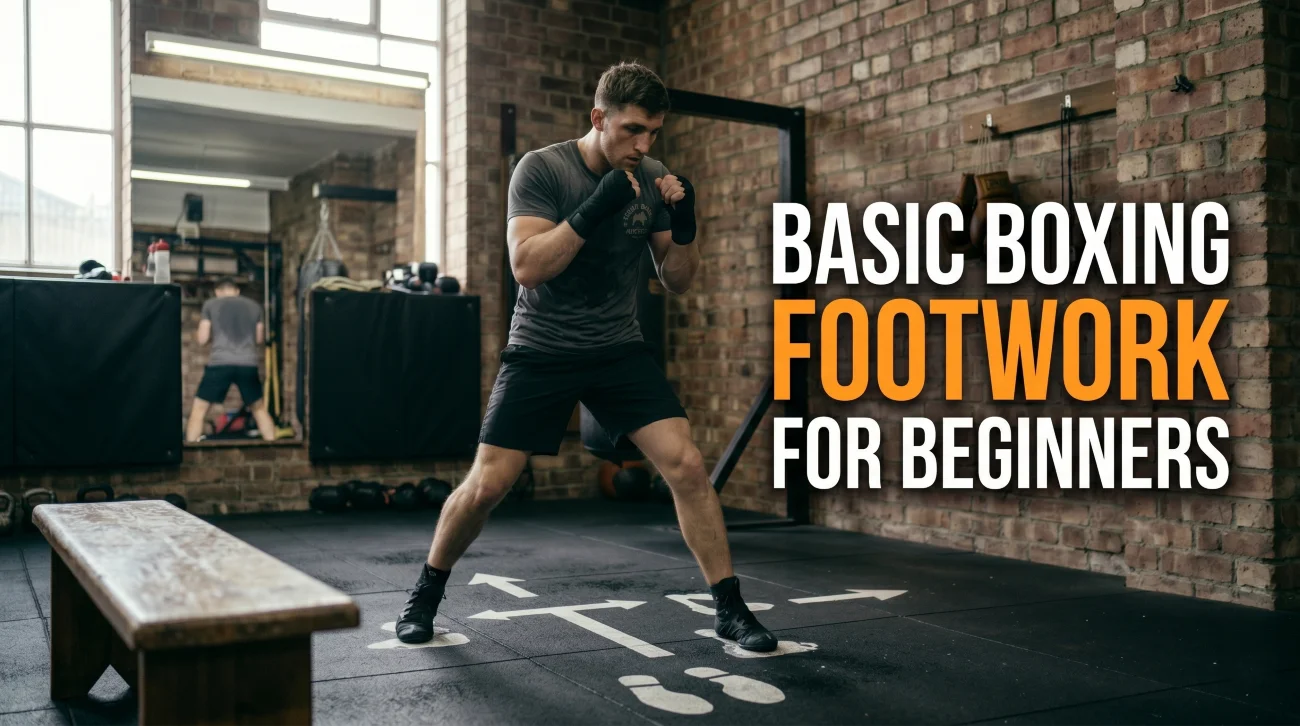
Basic Boxing Footwork for Beginners
Most beginners think boxing footwork means bouncing around like a professional fighter.
Then they try it in the gym, get tired after one round, cross their feet, lose balance, and wonder why their punches feel weak.
Basic boxing footwork is not about looking flashy. It is about staying balanced, moving without panic, punching from a stable position, and getting back out before you stand still in front of someone.
If you are new to boxing, your feet will probably feel awkward before your hands do. That is normal. You may know how to throw a jab in theory, but once you add movement, distance, defense, and a heavy bag that keeps swinging back at you, everything becomes harder.
This guide breaks down basic boxing footwork for beginners in a practical way. No complicated coaching language. No advanced ring-cutting systems. Just the movements, mistakes, and simple drills that help beginners stop feeling stuck, flat-footed, or off balance.
If you are also working on bag training, this article connects well with our guides on how to hit a heavy bag properly and common heavy bag mistakes.
Quick Answer: What Is Basic Boxing Footwork?
Basic boxing footwork means moving in your stance while staying balanced, protected, and ready to punch. For beginners, the most important skills are stepping forward, stepping back, moving left and right, pivoting, controlling distance, and returning to stance after every movement.
The simple rule is this:
Move your lead foot first when moving forward or toward your lead side. Move your rear foot first when moving backward or toward your rear side. Step, then bring the other foot with you. Do not cross your feet.
That sounds easy, but many beginners struggle because they try to punch, defend, breathe, and move all at once. What usually happens is they take big steps, stand too square, lean over the front foot, or bounce so much that they cannot actually throw with balance.
Your first goal is not speed. Your first goal is control.
Why Footwork Matters More Than Beginners Think
Beginners often think punches come from the arms. Coaches keep saying the power starts from the feet because it is true. Your stance, weight transfer, and balance decide whether your punches feel sharp or weak.
Bad footwork creates several problems at once:
- You reach for punches instead of stepping into range.
- You fall forward after throwing combinations.
- You cannot move away after hitting the bag.
- Your defense gets slower because your feet are stuck.
- Your shoulders and arms get tired because the legs are not helping.
If this sounds familiar, it does not mean you are bad at boxing. It usually means your hands are developing faster than your feet.
Footwork also controls distance. If you are too far away, you overextend. If you are too close, your punches jam. If you stand still, the bag swings into you or an opponent can reset comfortably.
Good boxing footwork gives you a base. From that base, your punches, defense, and movement start to make sense.
Start With Your Boxing Stance Before You Move
You cannot build good footwork on a broken stance.
For an orthodox boxer, the left foot is forward and the right foot is back. For a southpaw boxer, the right foot is forward and the left foot is back. Your feet should be about shoulder-width apart, with the rear heel slightly lifted and your weight balanced between both legs.
A good beginner stance should feel athletic, not stiff.
- Knees slightly bent
- Chin down
- Hands up
- Elbows relaxed
- Feet not too narrow
- Weight not leaning too far forward
Many beginners stand too tall. Others bend too much and burn their legs quickly. You want a position where you could move, punch, or defend without needing to reset your whole body.
A simple test: from your stance, try to take a small step forward, then backward, then throw a jab. If you feel like you have to reorganize your feet every time, your stance is probably too wide, too narrow, or too heavy on one side.
The Four Basic Boxing Steps
Step Forward
To move forward, step first with your lead foot. Then bring your rear foot with you to return to your normal stance width.
Do not drag your back foot lazily. Do not jump forward with both feet at the same time. The movement should be small, quiet, and controlled.
Forward movement is how you close distance behind the jab, enter range for combinations, or pressure the bag without leaning.
Step Back
To move backward, step first with your rear foot. Then bring your lead foot back into stance.
This is one of the most useful movements for beginners because it teaches you not to admire your punches. Hit, then move. Touch the bag, then get out. Throw a jab, then step back before the bag swings into you.
If you are practicing at home or in the gym, combine this with shadowboxing. Our guide on how to shadow box for beginners explains how to train movement without needing equipment.
Step Left
If your lead foot is on the left side, step left with your lead foot first. Then bring the rear foot with you.
The important thing is to keep your stance. Beginners often step left and let their feet come too close together. Once your feet are narrow, balance disappears.
Step Right
To move right from an orthodox stance, step first with the rear foot, then bring the lead foot with you.
Again, do not cross your feet. Crossing feels natural for walking, but boxing is not normal walking. The moment your feet cross, you are easier to push, easier to hit, and slower to punch back.
Basic Pivoting for Beginners
A pivot is a small turn that changes your angle without taking a big step.
For beginners, the easiest pivot to learn is the lead-foot pivot. Keep your lead foot in place, turn on the ball of that foot, and let your rear foot swing around so your stance faces a new angle.
This matters because boxing is not only forward and backward. If you only move in straight lines, you become predictable. Pivoting helps you get off the center line, escape after combinations, and create better punching angles.
Many beginners make pivoting too big. They spin, over-rotate, or let their hands drop. Keep it small at first. Think: jab, small pivot, reset. Or one-two, small pivot, hands back up.
Your shoes also matter here. Shoes with too much grip can make pivoting feel sticky. If you are unsure what to wear, see our guide on how to choose boxing shoes and the comparison of boxing shoes vs wrestling shoes.
Footwork Is Really Distance Control
A lot of beginner footwork problems are actually distance problems.
When you are too far from the bag, you reach. When you are too close, your punches feel crowded. When you do not know how to step in and out, you either swing from outside range or stand in front of the bag after every combination.
A simple way to practice distance is with the jab.
- Stand just outside jab range.
- Take a small step forward.
- Throw a relaxed jab.
- Bring the rear foot with you.
- Step back out of range.
Do this slowly. The point is not to throw hard. The point is to learn where your range begins and ends.
This is especially useful on the heavy bag. Many beginners hit the bag from the same spot for the whole round. Better training is to move in, punch, move out, circle, reset, and repeat.
Common Beginner Footwork Mistakes
Crossing the Feet
This is probably the most common mistake. Beginners move sideways like they are walking normally, so one foot crosses over the other.
The problem is balance. If you get touched while your feet are crossed, you have no base. You also cannot punch properly from that position.
Taking Huge Steps
Big steps feel powerful, but they make you slow. Boxing footwork is usually built from small adjustments.
Small steps keep you ready. Big steps force you to reset.
Bouncing Too Much
Many beginners copy professional fighters and start bouncing nonstop. It looks athletic, but it often wastes energy and makes punches weaker.
You can be light without bouncing every second. For beginners, calm stepping is usually better than nervous bouncing.
Standing Flat-Footed
The opposite mistake is standing too heavy. If both heels are glued to the floor, movement becomes slow.
You do not need to be on your toes like a dancer, but you should feel ready to move.
Moving Without the Hands
Some beginners move their feet and forget their guard. They step back with their chin up. They pivot with their hands down. They circle the bag while staring at their feet.
Footwork and defense should grow together. Move with your hands up, eyes forward, and chin tucked.
Real Gym Scenarios Where Footwork Shows Up
The Heavy Bag Starts Swinging
A beginner throws a hard combination, the bag swings back, and instead of stepping away, they stand there and absorb the bag with their body.
Better habit: after your combination, take a small step back or pivot out. Treat the bag like something that can hit you back.
You Miss the Jab
If you miss because you are too far away, do not just reach harder. Step into range first.
Footwork fixes many punching problems that beginners try to solve with arm strength.
You Get Tired After One Round
Sometimes the issue is not conditioning. It is inefficient movement.
If every step is too big, every bounce is unnecessary, and every punch pulls you off balance, you will gas out quickly. This connects directly with training frequency and recovery, which we cover in how often should you train boxing.
Simple Boxing Footwork Drills for Beginners
1. Step and Reset Drill
Start in stance. Step forward, reset. Step back, reset. Step left, reset. Step right, reset.
Do this for two or three minutes without punches. It may feel boring, but it teaches your body where your stance should be.
2. Jab In, Step Out
Step in with a jab, then step back out of range.
This drill teaches distance, balance, and not staying in front of the target after punching.
3. One-Two, Pivot
Throw a relaxed one-two, then pivot on your lead foot and reset.
Keep your hands up during the pivot. Do not admire the combination.
4. Circle the Bag Slowly
Move around the heavy bag without punching hard. Touch it with light jabs while circling.
Your goal is to keep the same distance while moving. This is harder than it sounds.
5. Shadowboxing With Footwork Only
Do one round where your main focus is foot placement. Punch lightly, move often, and reset after every short combination.
Beginners often learn faster when they remove power from the round.
Beginner Tips for Better Boxing Footwork
- Move less than you think you need to.
- Keep your feet under your body.
- Do not cross your feet during lateral movement.
- Practice slowly before adding speed.
- Use the jab to learn distance.
- Step out after combinations.
- Do not copy flashy footwork before learning basic steps.
- Train footwork when fresh, not only at the end of exhausting rounds.
Many beginners want advanced drills too early. The boring basics are what make the advanced movement possible later.
If you only have ten minutes, practice stance, step-and-reset, jab-in-step-out, and a few simple pivots. Done consistently, that will help more than random complicated ladder drills.
Safety Considerations
Footwork should not hurt your knees, ankles, or lower back. If you feel twisting pain, check your shoes, surface, and pivot mechanics.
Do not force pivots with your foot stuck to the floor. Turn on the ball of the foot. Keep the movement smooth. If your shoes are too grippy, the rotation may go into the knee instead of the foot.
Also, avoid doing high-volume footwork drills when you are exhausted and sloppy. Tired practice can build bad habits. Short, clean rounds are better for beginners.
And if you train on the heavy bag, protect your hands properly too. Footwork helps you punch from better positions, but you still need wraps and gloves. See our guide on how to wrap your hands for boxing if you are still learning the basics.
FAQ: Basic Boxing Footwork for Beginners
What is the first boxing footwork skill beginners should learn?
The first skill is moving in stance without crossing your feet. Learn to step forward, backward, left, and right while keeping your stance width and balance.
Should beginners bounce while boxing?
Beginners should not bounce constantly. Some light rhythm is fine, but excessive bouncing wastes energy and makes punches less stable. Controlled stepping is more important at first.
How do I stop losing balance when punching?
Check your stance and step size. You may be reaching too far, leaning over your front foot, or throwing punches before your feet are set. Practice light punches with step-and-reset drills.
How often should I practice boxing footwork?
You can practice basic footwork almost every training session. Even five to ten focused minutes before bag work or shadowboxing can help. Keep the reps clean instead of turning every drill into conditioning.
Can I learn boxing footwork at home?
Yes. Shadowboxing, step-and-reset drills, pivots, and distance practice can all be done at home with enough space. You do not need a bag to improve basic movement.
Why do my legs get tired so fast in boxing?
Your legs may be tired because you are too tense, bouncing too much, taking oversized steps, or staying too low in your stance. Efficient footwork should feel active but not frantic.
Do boxing shoes help footwork?
Yes, good boxing shoes can help with grip, pivoting, and balance. They will not fix bad technique, but they can make movement feel cleaner than running shoes or overly cushioned trainers.
Conclusion: Keep Boxing Footwork Simple at First
Basic boxing footwork for beginners comes down to balance, small steps, stance discipline, and distance control.
You do not need fancy movement to start improving. You need to stop crossing your feet, stop reaching for punches, stop bouncing without purpose, and learn how to step in and out without losing your shape.
Start with the four basic directions. Add simple pivots. Use the jab to learn range. Move around the heavy bag instead of standing in front of it. Practice slowly enough that your body actually remembers the movement.
Once your feet become more reliable, your punches will feel cleaner, your defense will feel calmer, and your training rounds will make much more sense.
Related Articles and Reviews
Check it now