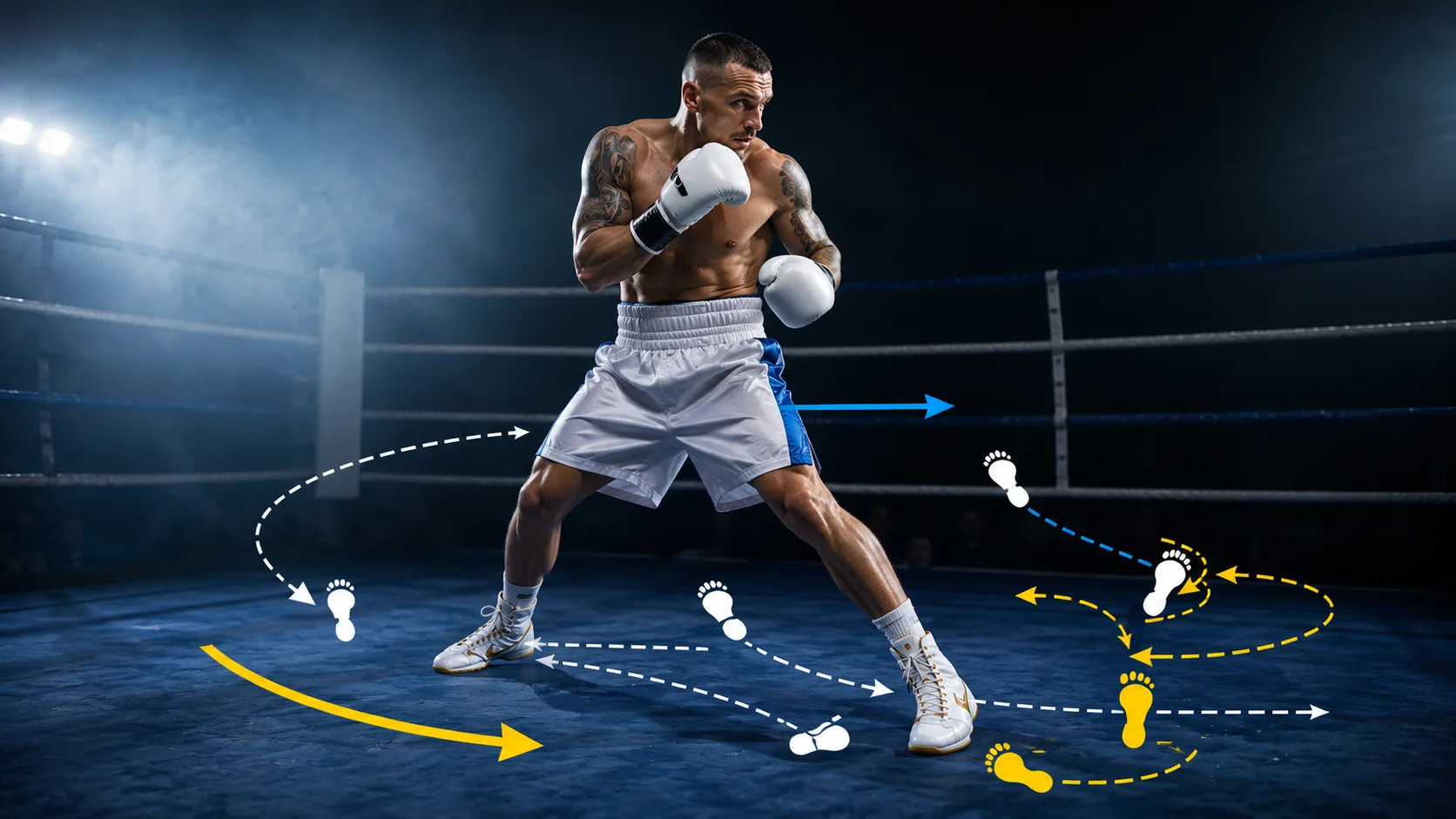
What Makes Usyk's Footwork So Effective?
Oleksandr Usyk does not look like the typical heavyweight problem.
He is not just standing in front of opponents trying to win every exchange with size, strength, and one huge punch. What makes him so difficult is that he rarely gives opponents a clean, comfortable target. He steps, slides, turns, resets, feints, changes rhythm, and makes the other fighter work before anything has even happened.
That is why many beginners watch Usyk and think, “His footwork looks simple. Why can nobody just walk him down?”
The answer is that Usyk's footwork is not just fast feet. It is timing, distance control, balance, positioning, rhythm, and discipline all working together. He moves with a purpose. He does not move just to look busy.
For beginner and intermediate boxers, this is important because Usyk is a great example of what good boxing footwork actually does. It is not dancing around the ring. It is not bouncing for no reason. It is using your feet to make punches safer, angles sharper, defense easier, and opponents more frustrated.
If you are building your own boxing base, this article will break down what makes Usyk's footwork so effective and what regular boxers can realistically learn from it without trying to copy every professional detail.
If you are still new to movement basics, you may also want to read our guide on how to shadow box for beginners, because shadowboxing is one of the easiest places to start practicing footwork without pressure.
Quick Answer: Why Is Usyk's Footwork So Good?
Usyk's footwork is effective because he uses it to control range, create angles, manage rhythm, and stay balanced while attacking or defending. He rarely moves randomly. Most of his steps help him either enter safely, exit after punching, turn an opponent, or make the opponent reset before throwing.
The key parts of Usyk's footwork are:
- Constant small adjustments instead of big, dramatic steps
- Excellent balance after punching
- Angle changes after combinations
- Southpaw positioning and lead-foot control
- Rhythm changes that make opponents hesitate
- Smart exits after exchanges
- Pressure through movement, not just forward walking
Many beginners think footwork means moving more. Usyk shows that better footwork often means moving with better timing and better purpose.
Why Footwork Matters More Than Beginners Realize
Many beginners start boxing by focusing almost completely on punches.
They want a harder jab, a faster cross, better hooks, and more power on the heavy bag. That makes sense. Punching feels like boxing. Footwork feels like the boring part at first.
But what usually happens is this: a beginner can hit the bag well, then gets into partner drills or light sparring and suddenly nothing works. The jab falls short. The right hand is too far away. The feet cross. The balance disappears. After throwing, they are stuck in front of the opponent.
That is not usually a punching problem. It is a positioning problem.
Footwork decides whether your punches are available in the first place. It also decides whether you are safe after throwing them.
Usyk is a great example because his punches do not exist separately from his feet. His jab is connected to his lead foot. His angles are connected to his exits. His pressure is connected to his ability to step just outside the opponent's comfort zone.
That is why his opponents often look slower than they really are. They are not only reacting to punches. They are reacting to position changes.
Usyk Uses Small Steps, Not Wasted Movement
One of the first things to notice about Usyk's footwork is that he does not rely on huge movements all the time.
A beginner often tries to move out of danger with a big jump backward or a wide step to the side. It feels safe for a second, but it usually creates new problems. The stance gets too wide. The feet come together. The boxer becomes too far away to counter. Or the opponent simply follows and resets the pressure.
Usyk often uses smaller steps that keep him balanced and ready.
Small steps allow him to:
- Stay close enough to punch
- Move without breaking stance
- React quickly in either direction
- Change angle without overcommitting
- Make opponents miss by inches instead of feet
This is a big lesson for normal training. You do not need to sprint around the ring to have good footwork. In many cases, the better skill is learning to move a few inches at the right time.
If this sounds familiar, try watching your own shadowboxing. Are your steps controlled, or are you jumping around and losing your base? If you cannot stop and punch at any moment, your movement is probably too loose.
Balance Is the Hidden Reason His Footwork Works
Fast feet are impressive, but balance is what makes footwork useful.
Usyk is rarely in a position where his feet are completely lost after he throws. Even when he shifts, pivots, or exits, he usually stays organized enough to punch again, defend, or move.
This matters because poor balance creates delays.
A boxer who oversteps has to recover before throwing. A boxer who leans too far forward has to pull back before defending. A boxer whose feet are too square cannot turn properly. Those small delays are exactly what experienced opponents punish.
Usyk avoids many of these problems by keeping his stance active but controlled. His feet are not glued to the floor, but they are also not flying everywhere. He can punch while moving because his weight is not constantly falling outside his base.
For beginners, this is one of the most useful takeaways from Usyk's footwork. Do not train footwork only as movement. Train it as movement plus balance.
Simple rule: after every step, ask yourself whether you can immediately jab, defend, or move again. If the answer is no, the step was probably too big or your stance collapsed.
Usyk Creates Angles Instead of Standing in the Same Line
One of the most effective parts of Usyk's boxing is how often he refuses to stay directly in front of his opponent after working.
Many beginners punch and admire their work. They throw a combination, then stay on the same line. Against the heavy bag, nothing bad happens. Against a person, that is where counters come back.
Usyk often finishes exchanges by stepping off, pivoting, or changing the angle. This makes the opponent turn before answering. That turn is important. Even a small reset can interrupt the opponent's counterpunching rhythm.
Good angles do several things:
- They make the opponent's guard face the wrong direction
- They open cleaner punching lanes
- They reduce the chance of a straight counter
- They force the opponent to spend energy resetting
- They make pressure fighters chase instead of cut the ring calmly
This is one reason Usyk can pressure without always looking like a classic pressure fighter. He is not just walking forward. He is stepping into positions where the opponent has to solve a new problem.
For your own training, this can be simple. After a jab-cross, do not always move straight back. Step out to the side. Pivot after the last punch. Imagine the opponent is trying to answer. Your goal is not just to punch. Your goal is to finish somewhere safer.
Southpaw Positioning Makes His Footwork Even More Difficult
Usyk's southpaw stance is a major part of why his footwork is so awkward for opponents.
When a southpaw faces an orthodox fighter, both boxers often care about lead-foot position. The outside foot angle can affect punching lanes, defensive exits, and who has the clearer straight shot.
Usyk is very good at using this battle without making it look obvious. He does not simply step outside and freeze. He adjusts, feints, steps again, and makes the opponent react to the movement.
This can make the straight left harder to read, force opponents to keep turning, and make normal defensive habits feel less reliable.
Beginners should be careful here. You do not need to switch southpaw just because Usyk is great at it. Copying stance without understanding the mechanics usually creates more confusion.
The useful lesson is simpler: foot position matters. Whether you are orthodox or southpaw, your feet decide your punching lanes. When your feet are lazy, your punches often become forced.
His Rhythm Changes Make Opponents Hesitate
Usyk's footwork is not only about where he steps. It is also about when he steps.
He changes rhythm constantly. Sometimes he bounces lightly. Sometimes he inches forward. Sometimes he pauses. Sometimes he steps in behind a feint. Sometimes he makes the opponent think an attack is coming, then resets.
This matters because opponents do not react only to punches. They react to rhythm.
If a boxer always moves at the same pace, the opponent can time him. If the jab always comes after the same bounce, it becomes easier to counter. If every entry has the same step, the opponent starts reading the pattern.
Usyk breaks that comfort.
He uses rhythm to make opponents ask questions: is he stepping in, feinting, jabbing, or baiting a reaction? That hesitation is valuable. A half-second of doubt can make a strong opponent look passive.
For beginner training, this does not mean you should dance around randomly. It means you should avoid being predictable. In shadowboxing and bag work, practice changing tempo. Step slowly, then jab quickly. Pause, then move. Do not make every round the same rhythm.
Usyk Controls Distance Before the Punches Start
Distance control is one of the most underrated parts of footwork.
Beginners often think they are either “in range” or “out of range.” But good boxing has many small distance layers. You can be close enough to make the opponent react, but not close enough for them to land clean. You can be just outside their jab. You can be near enough to step in quickly, but far enough to draw a mistake.
Usyk lives in those small spaces.
He often uses his feet to stay at a distance where the opponent feels uncomfortable. They want to punch, but he is slightly wrong for them. They want to reset, but he keeps stepping and touching with the jab. They want to pressure, but he changes angle before they can set their feet.
This is why his movement feels stressful to opponents. They are not just being hit. They are constantly being asked to judge distance again.
For more bag-specific training, our guide on how to hit a heavy bag properly explains why distance and balance matter more than just hitting hard.
His Exits Are Just as Important as His Entries
A lot of boxers train entries but forget exits.
They practice stepping in with the jab, throwing a combination, and landing clean. But after the combination, they stand still. In real exchanges, that is dangerous because the opponent's answer usually comes after your attack.
Usyk is effective because he often leaves the exchange on his terms.
He may:
- Step out after the final punch
- Pivot away from the power side
- Move the opponent backward before exiting
- Use a jab or feint to cover the exit
- Reset just far enough to start again
Many beginners do the opposite. They enter with energy, then exit lazily. What usually happens is they get countered at the end of their own combination.
A simple training habit can help: every time you finish a combination in shadowboxing, add an exit. It can be a small pivot, a step back, a step to the side, or a defensive move followed by a reset. Do not let the combination end with you frozen in front of an imaginary opponent.
Common Beginner Mistakes When Trying to Copy Usyk
Usyk is a great boxer to study, but beginners should not copy everything they see without context.
Here are the mistakes that show up often.
Mistake 1: Moving Too Much
Many beginners watch elite footwork and start bouncing constantly. The problem is that movement without balance becomes wasted energy. You should be able to punch, defend, or stop at any moment.
Mistake 2: Copying the Southpaw Stance Without a Reason
Usyk is a southpaw, but that does not mean every beginner should become one. If you are orthodox, learn orthodox footwork properly first. The lesson is positioning, not pretending to be a southpaw.
Mistake 3: Stepping Across Your Feet
Trying to create angles too quickly can make beginners cross their feet. This destroys balance and makes counters dangerous. Keep your stance structure even when moving.
Mistake 4: Forgetting the Hands
Footwork does not replace defense. When you move, your guard still matters. A lot of beginners step nicely but drop their hands during the movement.
Mistake 5: Practicing Footwork Only When Fresh
Footwork gets worse when you are tired. That is why you should practice controlled movement late in rounds, not only at the start when everything feels easy.
If your form falls apart under fatigue, our article on common heavy bag mistakes covers habits that make beginners look busy but train poor mechanics.
How Beginners Can Train Usyk-Style Footwork Safely
You cannot become Usyk by copying a few steps. But you can borrow useful principles from his movement.
Start With Stance Discipline
Before angles, rhythm, and pivots, make sure your stance survives movement. Step forward, back, left, and right without your feet crossing or coming too close together.
Add Small Pivots After Simple Combinations
Throw a jab-cross, then pivot. Throw a jab, step out. Throw a three-punch combination, then exit. Keep it simple. The goal is to connect hands and feet.
Use Shadowboxing Rounds for Footwork
Shadowboxing is where you can slow everything down and clean up details. Do not use every shadowboxing round to throw fast combinations. Spend some rounds focusing only on position, balance, and exits.
Practice Distance on the Heavy Bag
Use the bag as a target, not a wall. Step in to touch it, step out before it swings back, and move around it instead of standing still.
Wear Shoes That Let You Move Properly
Footwork also depends on the floor and footwear. If your shoes are too sticky, too soft, or too unstable, movement becomes harder than it needs to be. Our guide on how to choose boxing shoes explains what to look for when footwork becomes a serious part of training.
Beginner Tips for Better Boxing Footwork
If you want to improve your footwork, keep the training simple enough to repeat.
- Move in small steps before trying big angle changes.
- Keep your feet under you after every punch.
- Practice exits after every combination.
- Do not bounce just because professionals bounce.
- Use feints to enter, not just speed.
- Film one round of shadowboxing and check your stance.
FAQ: Usyk Footwork and Boxing Movement
What makes Usyk's footwork different?
Usyk's footwork is different because it combines balance, rhythm, small steps, southpaw positioning, and smart exits. He does not move just to avoid punches. He moves to control where the exchange happens.
Can beginners learn footwork from Usyk?
Yes, but beginners should focus on principles rather than copying every detail. Learn small steps, balance, angles, exits, and distance control before trying advanced rhythm changes.
Why is footwork so important in boxing?
Footwork helps you reach the opponent, avoid counters, create angles, stay balanced, and control distance. Without good footwork, even strong punches become harder to land safely.
Is Usyk's footwork mainly because he is a southpaw?
His southpaw stance helps, but it is not the only reason. His timing, balance, rhythm, exits, and ability to control distance are just as important.
How can I practice Usyk-style footwork at home?
Practice shadowboxing with small steps, pivots after combinations, and controlled exits. Focus on staying balanced after every movement instead of trying to move fast right away.
What is the biggest footwork mistake beginners make?
The biggest mistake is moving without purpose. Beginners often step too wide, cross their feet, or move after punching without staying balanced. Every step should help you attack, defend, or reset.
Conclusion: Usyk's Footwork Is Effective Because It Has Purpose
Usyk's footwork works because it is not random movement.
He uses his feet to control range, change angles, break rhythm, enter safely, exit after punching, and keep opponents uncomfortable. His movement is active, but it is also disciplined. That combination is what makes him so difficult to solve.
For beginner and intermediate boxers, the lesson is not to copy every detail. The lesson is to move with purpose.
Do not just bounce. Do not just run away. Do not throw combinations and stand still. Learn to step, punch, angle, and reset while staying balanced.
Related Articles and Reviews
Check it now