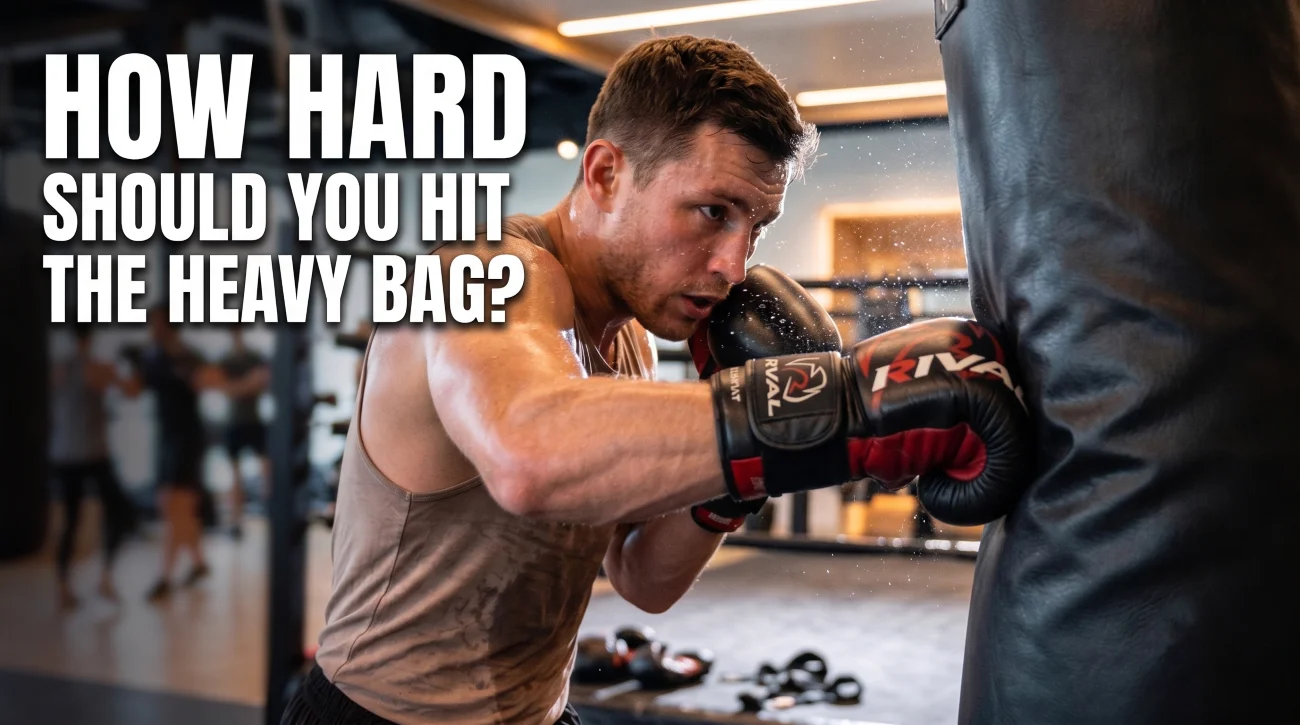
How Hard Should You Hit the Heavy Bag?
Most beginners hit the heavy bag too hard too early.
It feels natural. The bag is right in front of you, it does not hit back, and every loud thud feels like progress. But after a few rounds, the shoulders burn, the wrists feel strange, the punches get wider, and technique starts falling apart.
That is the real problem with heavy bag power. The question is not only how hard should you hit the heavy bag. The better question is: how hard can you hit while still staying balanced, relaxed, accurate, and technically clean?
For most beginners, the answer is lower than they think.
The heavy bag is not just a place to prove power. It is a tool for timing, distance, rhythm, conditioning, footwork, breathing, and punch mechanics. If every round becomes a maximum-power test, you miss most of the benefits and increase the chance of sore wrists, tight shoulders, and bad habits.
In this guide, we will break down how hard you should actually hit the heavy bag, when to punch harder, when to slow down, and how to build power without turning every session into a sloppy brawl with a hanging bag.
Quick Answer: How Hard Should You Hit the Heavy Bag?
Most beginners should hit the heavy bag at about 50–70% power for most rounds, with short bursts of harder punches only when technique stays clean.
You should be able to keep your stance, breathe normally, bring your hands back to guard, and move after every combination. If your punches make you fall forward, twist your wrist, hold your breath, or lose balance, you are hitting too hard for your current skill level.
A simple rule works well:
- Use light power for warm-ups, rhythm, and technique drills.
- Use medium power for most bag rounds.
- Use hard power only in short, controlled bursts.
- Do not use maximum power if your wrists, elbows, shoulders, or technique feel unstable.
Beginner rule: hit the bag hard enough to feel impact, but not so hard that your form breaks. Clean punches matter more than loud punches.
Why Beginners Usually Hit the Heavy Bag Too Hard
Many beginners treat the heavy bag like a strength test. They want to hear the loudest impact, move the bag as much as possible, and feel like they are training hard.
What usually happens is predictable. The first minute looks strong. Then the punches slow down. The chin lifts. The elbows flare. The rear hand drops after the cross. The feet stop moving. By the end of the round, the boxer is pushing the bag instead of punching it.
That is not power development. That is fatigue plus bad mechanics.
A heavy bag gives feedback, but beginners often read that feedback incorrectly. If the bag swings wildly, they think the punch was powerful. Sometimes it was. But often it means the punch was pushed, the body leaned too far forward, or the bag was hit with too much shove and not enough snap.
Power Is Not the Same as Effort
Good punching power feels sharp, connected, and relaxed. Bad power feels tense and forced.
If you are using your whole body correctly, a punch can land hard without feeling like you are trying to destroy the bag. The legs drive, the hips rotate, the shoulder protects the chin, the fist lands clean, and the hand returns fast.
If you are only using effort, you will usually see different signs: tight shoulders, slow recovery, poor breathing, and punches that push through the target instead of snapping into it.
This is why beginners should spend more time at controlled power. Medium power gives you enough impact to learn, but enough control to fix mistakes.
If you want to compare more bag-focused options, see our guide to the best boxing gloves for heavy bag training.
Heavy Bag Power Levels: Light, Medium, Hard, and Maximum
A useful way to think about bag work is to divide your power into levels. This keeps you from training every round at the same speed and intensity.
| Power Level | How It Feels | Best Use |
|---|---|---|
| Light | Relaxed, easy, technical | Warm-up, rhythm, stance, accuracy |
| Medium | Solid impact but controlled | Main beginner bag work |
| Hard | Powerful but still clean | Short combinations and conditioning bursts |
| Maximum | Near all-out effort | Rare use, only with good technique and protection |
Light Power: 30–50%
Light power is not useless. It is where you learn to stay relaxed, move your feet, breathe, and hit the bag without tension.
Use light power when you are warming up, learning a new combination, practicing a jab, or checking your stance. The goal is not damage. The goal is control.
If you struggle with balance, start here. A boxer who cannot stay balanced at light power will not magically become clean at full power.
Medium Power: 50–70%
Medium power should be your main zone for heavy bag training.
At this level, the punches are real. You feel the impact. You work the body. You build endurance. But you are not throwing yourself out of position on every shot.
This is where beginners improve fastest because they can repeat good mechanics for many rounds. You can practice the jab, cross, hooks, body shots, breathing, and exits without turning the session into chaos.
Hard Power: 70–90%
Hard power has a place, but it should be controlled and intentional.
Good examples:
- Finishing a combination with a hard right hand.
- Throwing a hard left hook after two lighter setup punches.
- Doing a 10-second power burst at the end of a round.
- Working body shots with clean hip rotation.
The key is that hard punches should still look like boxing. If your hands drop, your feet cross, your head stays on the center line, or your wrist bends on impact, reduce power immediately.
Maximum Power: Use Rarely
Maximum power is not where most of your development happens.
Going all-out too often makes you tense, tired, and sloppy. It can also expose weak wraps, poor glove choice, bad wrist alignment, and shoulder problems.
Save near-maximum punches for short, specific moments after you are warm and only if your body feels good.
Signs You Are Hitting the Heavy Bag Too Hard
You do not need a coach standing next to you to notice when the power is too high. Your body and technique will show it.
You Lose Balance After Punches
If a cross makes you fall forward or a hook spins you out of position, the punch is too hard for your current control.
A good punch should let you hit, recover, and move again. You should not need the bag to catch your body weight.
Your Wrist Hurts or Bends on Impact
Wrist discomfort is one of the clearest signs that something is wrong. It may be poor alignment, weak wrapping, bad glove support, or simply too much power too soon.
Your fist, wrist, and forearm should feel like one connected line on impact. If the wrist collapses, reduce power and check your wraps.
You Hold Your Breath
Many beginners hold their breath when they try to punch hard. Then they gas out quickly and the round becomes survival.
Every punch should have a short exhale. If you cannot breathe while punching, you are probably too tense. Our guide on how to breathe while boxing covers this in more detail.
Your Punches Become Wide and Slow
Power should not turn straight punches into loops. If your jab and cross start swinging from the outside, slow down.
Clean power travels through structure. Sloppy power travels through tension.
How to Build Heavy Bag Power Without Getting Sloppy
The goal is not to avoid power forever. The goal is to earn more power through better mechanics.
Start Every Round Clean
Begin each round at light or medium power. Use the first 30 seconds to find your stance, distance, breathing, and rhythm.
Once your body feels organized, add harder shots.
Build Power Inside Combinations
Do not throw every punch hard. That is one of the biggest beginner mistakes.
Instead, mix levels:
- Light jab, medium cross, hard left hook.
- Double jab, hard right hand, step out.
- Light head shots, hard body shot, reset.
- Medium one-two, hard cross to finish.
This teaches rhythm and realism. In boxing, power usually works better when it is set up.
Return to Guard After Every Punch
The heavy bag does not punish lazy defense, but sparring will.
After every punch, bring the hand back. After every combination, reset your feet or move out. Even on the bag, train as if something could come back.
Use Your Feet and Hips
Real power starts from the floor. If your feet are flat, your knees locked, or your hips frozen, your shoulders will try to do all the work.
That creates arm punches. They may feel hard for a few seconds, but they tire you quickly and usually lack real snap.
If you are still unsure about stance and weight balance, read our boxing stance guide for beginners before adding more power.
Protect Your Hands Before You Increase Power
If this sounds familiar, pay attention: your punches feel strong, but your knuckles, wrists, or thumbs feel sore after bag rounds.
That is often not a toughness problem. It is a protection and technique problem.
Before you hit the heavy bag harder, make sure you have three basics in place:
- Proper hand wraps.
- Gloves that are suitable for bag work.
- Straight wrist alignment on impact.
Hand wraps matter because they help keep the small bones of the hand and the wrist supported. Gloves matter because different gloves protect differently. Some soft sparring gloves are comfortable but may not feel ideal for sharp, repeated heavy bag impact.
For more support-focused options, see our guide to the best boxing gloves for wrist support.
How Hard to Hit the Heavy Bag Based on Your Goal
Not every heavy bag round has the same purpose. Your power should change based on what you are training.
For Technique
Use 40–60% power.
Focus on stance, balance, hand return, chin position, and clean contact. This is the best intensity for learning new combinations or fixing mistakes.
For Conditioning
Use 50–75% power.
You want enough impact to work hard, but not so much that you burn out in the first minute. Conditioning improves when you can sustain quality work.
For Power Development
Use short bursts at 75–90% power.
Throw one or two hard shots inside a combination, then reset. Do not throw full-power punches for an entire round unless you already have solid technique and conditioning.
For Speed and Rhythm
Use 30–60% power.
Speed rounds should feel sharp and relaxed. The bag should not become a wrestling match. Touch, move, breathe, and change rhythm.
For Stress Relief
Use control, not chaos.
The heavy bag is great for stress, but emotional punching often creates bad form. If you are angry, start light, breathe, and increase power only when your movement stays clean.
Common Beginner Mistakes When Hitting Hard
Pushing the Bag Instead of Punching It
A clean punch lands and comes back. A push drives through the bag and leaves your body leaning forward.
If the bag swings too much, do not automatically celebrate. Ask whether you snapped the punch or shoved it.
Throwing Every Punch at the Same Power
Real boxing has rhythm. Some punches set up. Some punches score. Some punches hurt.
On the bag, beginners often throw every punch at one speed and one power level. This makes combinations predictable and tiring.
Ignoring Footwork
Power without footwork becomes messy. After a hard combination, move. Step around the bag, reset your stance, or create an angle.
If your feet never move, your heavy bag work becomes less realistic.
Training Hard Before Warming Up
Cold shoulders and wrists do not like sudden maximum power.
Start with shadowboxing, light bag touches, and gradual intensity. Then build into harder combinations.
Simple Heavy Bag Round Structure for Beginners
Here is a practical way to control power during a three-minute round.
| Time | Power | Focus |
|---|---|---|
| 0:00–0:45 | Light | Jab, stance, breathing, distance |
| 0:45–1:45 | Medium | Basic combinations and footwork |
| 1:45–2:30 | Medium-hard | Add harder final shots |
| 2:30–2:50 | Hard burst | Short controlled power combination |
| 2:50–3:00 | Light | Recover, move, breathe, reset |
This structure teaches you not to panic or rush. You learn to build intensity instead of exploding for 30 seconds and surviving the rest of the round.
If you are still learning basic punch mechanics, start with our guide on how to throw a jab correctly and then connect that jab to heavier combinations.
When Should You Hit the Heavy Bag Hard?
You should hit the heavy bag hard when you are warm, balanced, wrapped properly, wearing suitable gloves, and able to keep your technique clean.
Hard punches make sense when they have a purpose:
- Practicing a power cross after a jab.
- Finishing a combination with a strong body shot.
- Conditioning your body for higher-intensity rounds.
- Learning to stay relaxed while throwing force.
They do not make sense when you are tired, angry, cold, injured, or trying to impress people in the gym.
A hard punch should still be a boxing punch. It should not look like you are throwing your whole body into the bag and hoping your wrist survives.
For a broader comparison, check the best boxing gloves for training.
FAQ: How Hard Should You Hit the Heavy Bag?
Should beginners hit the heavy bag hard?
Beginners should not hit the heavy bag hard for full rounds. Most should train around 50–70% power and use harder punches only in short, controlled moments.
Is it bad to hit the heavy bag as hard as possible?
It can be bad if your technique, wrist alignment, breathing, or balance breaks down. Maximum power should be used rarely and only when you are warm and technically stable.
Why do my wrists hurt when I hit the heavy bag hard?
Wrist pain can come from poor alignment, weak hand wrapping, unsuitable gloves, or hitting harder than your structure can support. Reduce power and check your wraps and glove support.
Should the heavy bag swing a lot when I punch it?
Not always. A wildly swinging bag can mean you are pushing instead of punching. Clean punches usually create sharp impact without needing to shove the bag across the room.
How do I know if my heavy bag power is improving?
Your power is improving when punches feel sharper, you stay balanced, you recover faster after combinations, and you can hit harder without losing form.
Can I build punching power with only the heavy bag?
The heavy bag helps, but power also depends on technique, stance, hip rotation, strength, conditioning, and relaxation. Shadowboxing, footwork, pads, and coaching all matter.
How many hard punches should I throw per round?
For beginners, a good starting point is a few hard punches inside each round, not every punch. Try short 10-second bursts or one hard finishing shot after lighter setup punches.
Final Thoughts
You should hit the heavy bag hard enough to train real impact, but not so hard that you stop boxing well.
For most beginners, that means medium power most of the time, lighter power for skill work, and hard power in short bursts. The goal is not to win against the bag. The goal is to become a better boxer.
If your punches stay balanced, relaxed, accurate, and protected, you can gradually add more power. If your form breaks, reduce power and rebuild the basics.
The best heavy bag rounds are not always the loudest. They are the rounds where your punches, feet, breathing, and defense all stay connected.