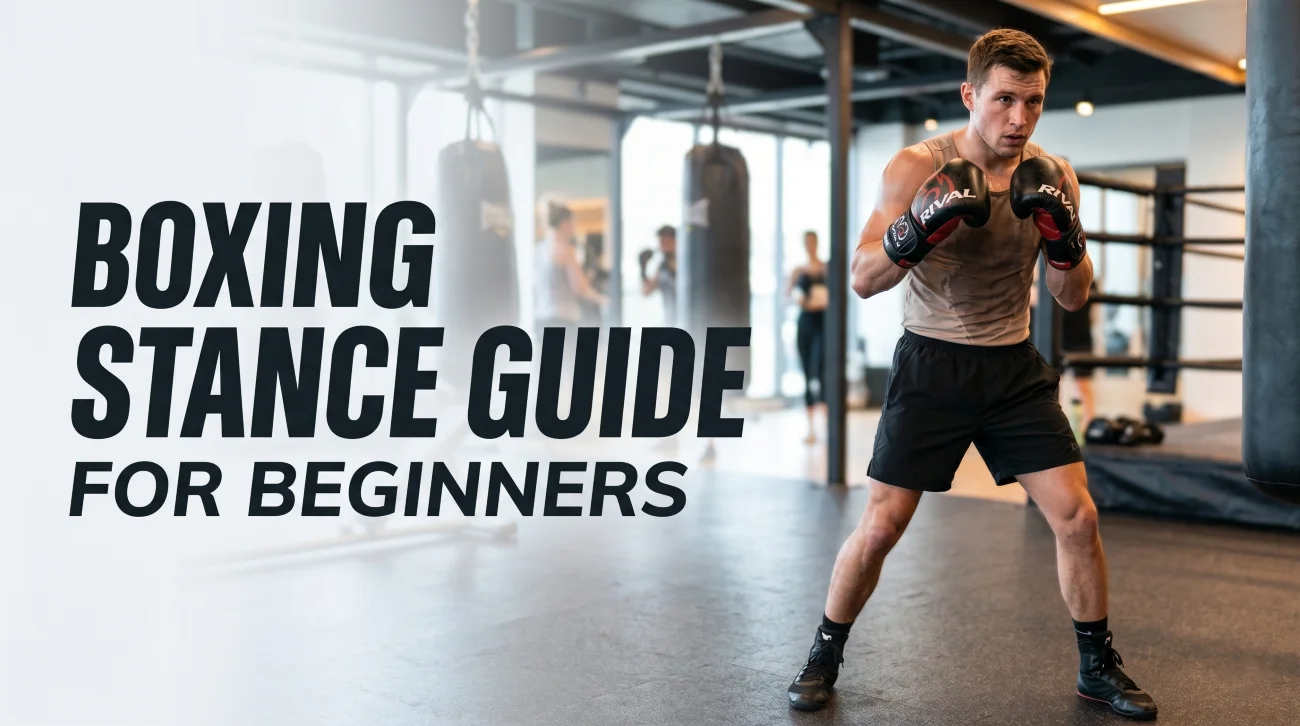
Boxing Stance Guide for Beginners
Your boxing stance is the first thing that decides whether your punches feel sharp, your defense works, and your feet stay under you.
Many beginners think stance is just “left foot forward, hands up.” Then they start hitting the heavy bag and everything falls apart. The feet become too wide. The chin comes up. The back heel gets stuck. The jab feels weak. The cross throws them off balance.
If this sounds familiar, the problem is probably not your effort. It is the base you are punching from.
A good boxing stance does not need to look fancy. It needs to help you stand balanced, punch without falling in, defend without freezing, and move without crossing your feet.
This boxing stance guide for beginners breaks down what actually matters: foot position, weight balance, guard, chin position, orthodox vs southpaw, common mistakes, and simple drills you can use in shadow boxing, bag work, and beginner classes.
If you are building your fundamentals, this article works especially well with our guides on basic boxing footwork for beginners, how to throw a jab correctly, and how to breathe while boxing.
Quick Answer: What Is the Correct Boxing Stance for Beginners?
A good beginner boxing stance should be balanced, slightly bladed, and easy to move from.
For an orthodox stance, your left foot is forward and your right foot is back. For a southpaw stance, your right foot is forward and your left foot is back.
Your feet should be about shoulder-width apart, with the rear heel slightly raised, knees soft, chin tucked, hands up, elbows close enough to protect the body, and your weight balanced between both legs.
The goal is simple: you should be able to punch, defend, step, pivot, and return to position without losing balance.
Beginner rule: if your stance makes it hard to move, hard to breathe, or hard to bring your hands back to your face, it is probably too stiff, too wide, or too square.
Boxing Stance Basics: The Foundation
Before you worry about combinations, speed, or power, you need a stance that keeps you organized.
A boxing stance is not a static pose. It is a ready position. You are not standing still for a photo. You are preparing to punch, slip, block, step, pivot, and reset.
That is why beginners should think about stance as a working position, not a perfect shape.
Your stance should give you four things
- Balance when you punch
- Protection when punches come back
- Mobility in every direction
- A natural path back to guard after every action
If one of those breaks, the stance needs adjustment.
For example, if you can punch hard but cannot move, your stance is too heavy. If you can bounce around but fall forward when you jab, your stance is too loose. If your hands are high but your chin is in the air, your guard is incomplete.
Orthodox vs Southpaw: Which Boxing Stance Should You Use?
Most beginners start by asking whether they should box orthodox or southpaw.
In an orthodox stance, your left foot and left hand are forward. Your right hand is your rear power hand. This is the most common stance for right-handed boxers.
In a southpaw stance, your right foot and right hand are forward. Your left hand is your rear power hand. This is common for left-handed boxers, but some right-handed fighters also choose it for tactical reasons.
Simple beginner rule
If you are right-handed, start orthodox. If you are left-handed, start southpaw.
This is not an unbreakable law, but it is the easiest starting point. Your stronger hand usually works better in the rear position because the rear hand travels farther and often carries more power.
The lead hand has a different job. It jabs, measures distance, blocks vision, touches the guard, starts combinations, and helps you control rhythm.
Some beginners want to switch stance immediately because it feels interesting. That is fine later, but at the start, pick one stance and build stability. Switching too early can slow down your footwork, defense, and punch mechanics.
Foot Position: How to Place Your Feet
Your feet are the base of your boxing stance. If the feet are wrong, everything above them becomes harder.
Step 1: Start shoulder-width apart
Stand with your feet around shoulder-width apart. Then place one foot forward and one foot back.
You do not want your feet on the same line like you are walking on a tightrope. That makes you easy to push off balance. You also do not want them extremely wide like a deep squat. That makes movement slow.
A good beginner stance feels athletic. You should feel like you can move forward, backward, left, and right without needing to reset first.
Step 2: Turn slightly sideways
Your body should be slightly bladed, not completely square and not completely sideways.
If you stand too square, your body becomes a bigger target and your rear hand loses some structure. If you stand too sideways, your rear hand becomes harder to throw and your balance can suffer.
Think of showing your opponent less of your chest, but still keeping both hands available.
Step 3: Keep the rear heel light
Your rear heel should usually be slightly raised or at least light enough to pivot.
Many beginners glue the back heel to the floor. What usually happens is their cross becomes an arm punch. They cannot rotate the hip, so they compensate by leaning forward.
A light rear heel helps you turn the hip, pivot the foot, and bring the punch back without collapsing into the bag.
Weight Balance: Where Should Your Weight Be?
A common beginner mistake is putting too much weight on the front foot. This makes it harder to move, defend, and react.
For most beginners, a good starting point is keeping slightly more weight on the rear leg — roughly 60/40 or 55/45. The exact number is not important. What matters is feeling balanced and ready to move in any direction.
A slight rear-leg bias helps you stay relaxed, move backward quickly, and avoid falling into your punches. It also makes it easier to push off the back foot when throwing straight punches.
Your Weight Should Shift Naturally
Weight distribution is not fixed. It changes constantly while you move and punch.
When you throw a rear cross, more weight naturally transfers toward the lead side. When you reset, pivot, or move, the balance shifts again. Good boxers do not freeze at a specific percentage — they stay athletic and ready to move.
Soft Knees Matter More Than Exact Numbers
You do not need to squat low like you are preparing for a leg workout. You just need soft knees.
Soft knees help you absorb movement, change direction, and stay ready. Locked knees make you stiff. Over-bent knees make you tired and slow.
A simple test: from your stance, can you step forward, step back, throw a jab, and still feel balanced? If yes, your weight distribution is probably close to where it should be.
Hand Position and Guard
Your guard is part of your stance. It is not separate.
For beginners, the safest starting point is a simple high guard:
- Lead hand near cheek level or slightly forward
- Rear hand close to the chin
- Elbows relaxed and near the ribs
- Shoulders loose, not shrugged hard
- Chin tucked behind the lead shoulder when punching
Many beginners hold their hands high for the first ten seconds, then slowly drop them. This usually happens because the shoulders are too tense.
Do not squeeze your fists the whole time. Stay relaxed until the moment of impact. If your arms are tense before you punch, your punches become slower and your guard gets tired quickly.
Elbows should protect without locking you up
Keep your elbows close enough to protect your body, but not so tight that your punches cannot come out naturally.
A beginner often makes one of two mistakes:
- Elbows flare out, leaving the body open
- Elbows squeeze too tightly, making punches stiff
The middle position is usually best: compact, relaxed, and ready.
Head and Chin Position
A boxing stance is not only about feet and hands. Your head position matters immediately.
Keep your chin slightly tucked. Your eyes should look forward, not down at the floor.
This sounds simple, but beginners often lift the chin when they punch, especially on the jab or cross. They try to reach the target with their face instead of stepping or rotating correctly.
A raised chin makes you easier to hit and easier to hurt. A tucked chin does not mean staring at the floor. It means your jaw is protected and your eyes still see what is happening.
Do not hide behind your gloves
Another beginner mistake is covering the face so much that you cannot see.
Your gloves protect you, but your eyes are your first defense. You need to see punches, distance, and movement.
Think “chin down, eyes up.”
Common Beginner Boxing Stance Mistakes
Most stance problems are not dramatic. They are small habits that repeat every round until they become automatic.
Standing too square
When beginners stand too square, both shoulders face the target. This makes them feel strong at first, especially on the heavy bag.
The problem is defense. A square stance gives the opponent a bigger target and makes it harder to use the lead shoulder, jab, and rear hand correctly.
Standing too sideways
Some beginners copy slick defensive fighters and turn almost completely sideways.
That can work for advanced boxers with specific styles, but it usually creates problems for beginners. The rear hand becomes awkward, the feet cross more easily, and movement becomes narrow.
Feet too close together
If your feet are too close, you will lose balance when punching or defending.
This often shows up when a beginner throws a cross and the rear foot slides in too close behind the front foot. Suddenly the stance becomes tall and unstable.
Feet too wide
A wide stance feels powerful until you need to move.
If your stance is too wide, you may punch hard on the bag but struggle with footwork drills, angles, and resets. You become planted instead of ready.
Leaning forward
Leaning forward is one of the most common beginner habits.
It usually happens when the boxer wants to reach the target but does not step correctly. The head moves past the lead knee, the back foot becomes useless, and recovery becomes slow.
Dropping the rear hand
Beginners often drop the rear hand when throwing the jab.
On the heavy bag, nothing punishes this immediately. In sparring, it becomes a problem fast. Even in shadowboxing, train the habit of keeping the non-punching hand home.
How Your Stance Affects Punching
Your stance decides how your punches feel.
A jab from a balanced stance is fast and easy to recover. A jab from a leaning stance feels longer, but it leaves you exposed. A cross from a stable stance uses the rear foot and hip. A cross from a stuck stance becomes an arm swing.
This is why coaches constantly tell beginners to fix their feet before adding more combinations.
The jab needs balance
The jab should not pull you out of stance.
When you throw it, your lead shoulder can rise slightly, your chin stays tucked, and the rear hand stays home. After the punch, the hand returns directly back to guard.
If your jab makes you fall forward, go back to your stance. The punch is exposing the base problem.
The cross needs rotation
The rear hand needs the rear foot and hip.
Beginners often try to create power by reaching with the shoulder. A better approach is to rotate from the floor: rear foot turns, hip turns, shoulder follows, hand lands, then everything returns.
If you are working on punch mechanics, read our full guide on how to throw a jab correctly first, then build the cross after your stance feels stable.
How Your Stance Affects Footwork
Footwork is much easier when your stance is already organized.
Beginners often lose stance when they move. They start correctly, step once, then end up square, crossed, too narrow, or too wide.
The rule is simple: move, then return to stance.
Small steps beat big jumps
In beginner boxing, small controlled steps are usually better than big dramatic movement.
When moving forward, the front foot moves first and the back foot follows. When moving backward, the back foot moves first and the front foot follows. When moving left, the left foot moves first. When moving right, the right foot moves first.
This keeps your base underneath you.
For a deeper breakdown, use our basic boxing footwork for beginners guide alongside this stance article.
Do not cross your feet
Crossing your feet is one of the fastest ways to lose balance.
It usually happens when a beginner tries to move too far in one step. Keep your steps short enough that your stance shape survives the movement.
Using Your Boxing Stance on the Heavy Bag
The heavy bag is useful, but it also hides mistakes.
The bag does not hit back. That means beginners can stand too close, lean forward, drop their hands, and still feel successful because the bag moves.
When training stance on the bag, focus less on smashing it and more on staying organized after every punch.
- Start in stance before each combination
- Keep your chin tucked when punching
- Return both hands to guard
- Do not let your feet become too narrow
- Step out after combinations instead of admiring the bag
- Breathe on punches so your shoulders stay relaxed
If you are still learning bag work, read how to hit a heavy bag properly and common heavy bag mistakes. Both connect directly to stance, balance, and recovery.
Simple Boxing Stance Drills for Beginners
You do not need complicated drills to improve your stance. You need repeated, honest practice.
Mirror stance check
Stand in front of a mirror in your boxing stance.
- Check that your feet are not on one line.
- Check that your knees are soft.
- Check that your rear heel is light.
- Check that your chin is tucked.
- Check that your hands are protecting your face.
Hold the stance for a few seconds, relax, then rebuild it. The goal is to make the correct position easy to find.
Step and reset drill
From stance, take one small step forward and reset. Then one step back and reset. Then left. Then right.
Do not rush. The point is not speed. The point is keeping the stance shape after movement.
Jab and freeze drill
Throw one jab and freeze immediately after it returns.
Ask yourself:
- Did my rear hand stay up?
- Did my chin stay down?
- Did my feet stay balanced?
- Can I move right now?
If the answer is no, slow down.
Shadowboxing stance rounds
Do one round of shadowboxing where the only goal is maintaining stance.
No fancy combinations. Jab, step, reset. Double jab, step out, reset. Slip slightly, return to stance. Pivot, reset.
If you are new to this, our guide on how to shadow box for beginners will help you structure simple rounds.
Does Gear Affect Your Boxing Stance?
Gear will not fix a bad stance, but it can make training easier or harder.
Shoes matter because your feet need traction without feeling stuck. Running shoes often have too much cushioning and can make pivots feel clumsy. Boxing shoes give better floor feel and support cleaner movement. If you are not sure what to buy, read how to choose boxing shoes or compare boxing shoes vs wrestling shoes.
Gloves also matter indirectly. Oversized, uncomfortable, or badly balanced gloves can make beginners drop their hands faster. If you are still choosing your first pair, see best boxing gloves for beginners or boxing gloves size guide.
Hand wraps are important too. They do not create stance, but they help you train with more confidence because your hands and wrists feel more secure. A useful starting point is our guide on how to wrap your hands for boxing.
Beginner Tips for Building a Better Boxing Stance
- Start every round by checking your feet before your hands.
- Keep your stance narrow enough to move but wide enough to stay balanced.
- Do not chase power before you can punch and recover.
- Use short steps instead of jumping around the gym.
- Keep your rear hand home when you jab.
- Do not hold your breath in stance or during punches.
- Film one round of shadowboxing and look only at your feet.
- Reset after every mistake instead of continuing from a broken position.
The best beginner stance is not the one that looks most dramatic. It is the one you can keep under pressure.
FAQ: Boxing Stance for Beginners
What is the best boxing stance for beginners?
The best boxing stance for beginners is a balanced orthodox or southpaw stance with feet shoulder-width apart, knees soft, hands up, chin tucked, and weight balanced between both legs. It should feel stable but easy to move from.
Should my dominant hand be in front or back in boxing?
Most beginners should keep the dominant hand in the rear position. Right-handed beginners usually start orthodox, while left-handed beginners usually start southpaw. This gives the rear hand more power and keeps the lead hand available for jabs and distance control.
How wide should my boxing stance be?
Your boxing stance should be roughly shoulder-width apart, with one foot forward and one foot back. If your feet are too close, you lose balance. If they are too wide, you lose mobility.
Should my back heel be off the ground in boxing stance?
Your rear heel should usually be light or slightly raised so you can pivot and rotate. Beginners who keep the back heel glued to the floor often struggle to throw a proper cross or move smoothly.
Why do I lose balance when I punch?
You may be leaning forward, standing too narrow, reaching with your punches, or putting too much weight on the front foot. Slow down and check whether you can punch, bring the hand back, and still move immediately.
Is it bad to switch stance as a beginner?
It is usually better to learn one stance first. Switching stance too early can make your footwork and defense messy. Once your basic stance, jab, guard, and movement are stable, stance switching becomes easier to explore.
How long does it take to feel comfortable in boxing stance?
Most beginners start feeling more comfortable after a few weeks of consistent practice, but stance continues improving for years. The key is repeating good habits in shadowboxing, footwork drills, bag work, and sparring.
Can I practice boxing stance at home?
Yes. You can practice stance, stepping, guard position, and shadowboxing at home without equipment. Use a mirror or phone video to check whether your feet stay balanced and your hands return to guard.
Conclusion: Build Your Boxing Stance Before Chasing Power
A good boxing stance is not about looking like a professional fighter on day one. It is about having a base that lets you punch, defend, move, and recover without panic.
Start simple. Pick orthodox or southpaw. Set your feet shoulder-width apart. Keep your knees soft, rear heel light, chin tucked, and hands ready. Then practice moving without losing that shape.
If your stance improves, everything else gets easier: jab, cross, breathing, footwork, defense, and heavy bag training.
That is why stance is not just the first boxing lesson. It is the lesson you keep coming back to.
Related Articles and Reviews
Check it now